POLS 1140

Models of Democratic Choice

Updated Mar 19, 2026

Monday

Plan

  • Announcements

  • Finish discussion of models of political cognition

  • Begin discussion of retrospective voting (DfR Chapter 4/5)

    • Selection and Sanctioning
    • Blind retrospection
  • Begin discussion of Economic voting (DfR Chapter 6)

  • Next week: Finish Economic voting, Course review

Assignments

  • Let’s talk about the group projects

  • Reading Reflections:

    • 1st by Feb 27 – Feedback end of next week
    • 2nd by April 2
    • 3rd by Apr 30 (Optional, replace lowest grade)
  • First Term Paper now due March 17

Attendance survey?

Click here be the change you want to see in this class

The Cavs absolutely mogged the Knicks on Tuesday

Term Papers

  • Here’ is the prompt for your first term paper

  • Here’s the grading rubric

  • Due March 17, 2026 by midnight.

Term Papers: Prompt

Using what you’ve learned about public opinion in the course so far, make the case for or against citizens’ competence in a democracy. Whatever side you take in this debate, present the best evidence for your argument, consider the strongest objections to that argument, and reassure us that your claims stand inspite of these arguments. Along the way, you may want to offer some discussion of what you mean by competence, and the various roles that citizens and their opinions might play in a democracy. You should conclude by discussing the implications of your argument for democratic theory, politics, and policy.

Term Papers: Structure

You may structure your paper how you please, but something like:

  • Introduction (~1-2 pages)
  • Argument (~3-4 pages)
  • Critique (~1-2 pages)
  • Response (~1-2 pages)
  • Conclusion (~1-2 pages)

will make it easier for your reader (and grader) to follow along.

  • Length: 7-12 pages double-spaced, 1-inch margins, 12 point font

Zaller and Feldman 1992

Take a few moments to review

  • What’s the research question
  • What’s the theoretical framework
  • What’s the empirical design
  • What are the results
  • What are the conclusions

What’s the research question

What’s the research question

Why are survey responses:

  • So unstable over time?

  • So sensitive to question wording and order?

Do citizens:

What’s the theoretical framework

Background:

  • Zaller and Feldman address research on response instability (Converse 1964) and response effects (question wording/order effects)

  • Reject the assumption that citizens possess fixed, survey-ready attitudes. Attitudes are not revealed — they are constructed.

“… people are using the questionnaire to decide what their”attitudes” are (Bishop, Oldendick, and Tuchfarber 1984; Zaller 1984; Feldman 1990).” (p. 582)

  • Citizens formulate responses to surveys from the top of their head

What’s the theoretical framework

Three axioms:

Axiom 1: The ambivalence axiom. Most people have competing considerations on most issues.

What’s the theoretical framework

Three axioms:

Axiom 1: The ambivalence axiom.

Axiom 2: The response axiom. Survey answers reflect an average of the considerations currently salient.

What’s the theoretical framework

Three axioms:

Axiom 1: The ambivalence axiom.

Axiom 2: The response axiom.

Axiom 3: The accessibility axiom. Salience depends on stochastic sampling — recently activated ideas are more likely to be used.

What’s the theoretical framework

  • Zaller and Feldman’s (1992) framework provide the microfoundations for the Recieve-Accept-Sample model of mass opinion developed by Zaller (1992)

  • Rather than read two chapters, we read one article and rely on me to flesh out the RAS model this week and next

Preview
Concepts

  • Consideration: Any reason that might induce an individual to decide a political issue one way or another.

  • Political Awareness: “the extent to which an individual pays attention to politics and understands what he or she has encountered.” (Zaller 1992, p. 21) generally measured by standard PK-scales

  • Predispositions: stable, individual-level traits that regulate the acceptance or non-acceptance of the political communications the person receives” (Zaller 1992 p. 22)

  • Ambivalence: A person is ambivalent when they hold multiple, conflicting considerations

    • Bipolar vs Bipartite scales

What’s the empirical design

  • Goal: Directly observe “considerations”

  • Two-wave panel data from the 1987 Pilot Study of the NES

  • Outcomes: Close-ended policy items (job guarantees, government services, and aid to Blacks)

  • Paired with:

    • Retrospective Probes (Provide answer than explain)
    • Prospective (List considerations then provide answer)
  • Key move: Link open ended considerations to close ended responses

  • Responses coded a number of ways (p. 589) to capture “ambivalence”

Retrospective Probes:

  • Retrospective: “designed to find out what exactly was on people’s minds at the moment of response”

Still thinking about the question you just answered, I’d like you to tell me what ideas came to mind as you were answering that question. Exactly what things went through your mind. (Any others?)

Prospective Probes

  • Stop and Think: “designed to induce people to search their memories more carefully than they ordinarily would for pertinent considerations.”

Before telling me how you feel about this, could you tell me what kinds of things come to mind when you think about government making sure that every person has a good standard of living? (Any others?)

Now, what comes to mind when you think about letting each person get ahead on their own? (Any others?)

What are the results

What are the results

Model purports to explain a lot
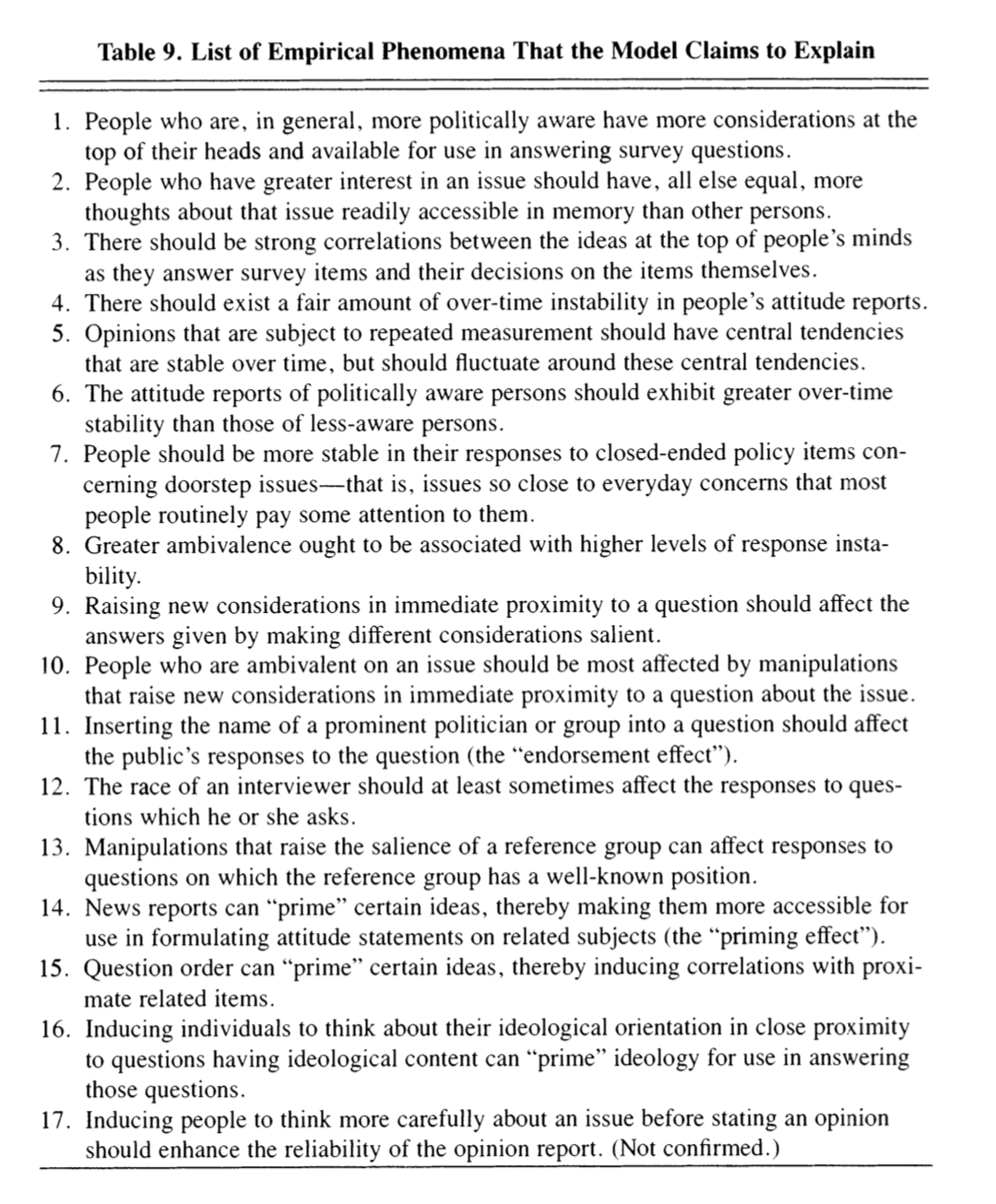
What are the results

Let’s condense these into the following claims:

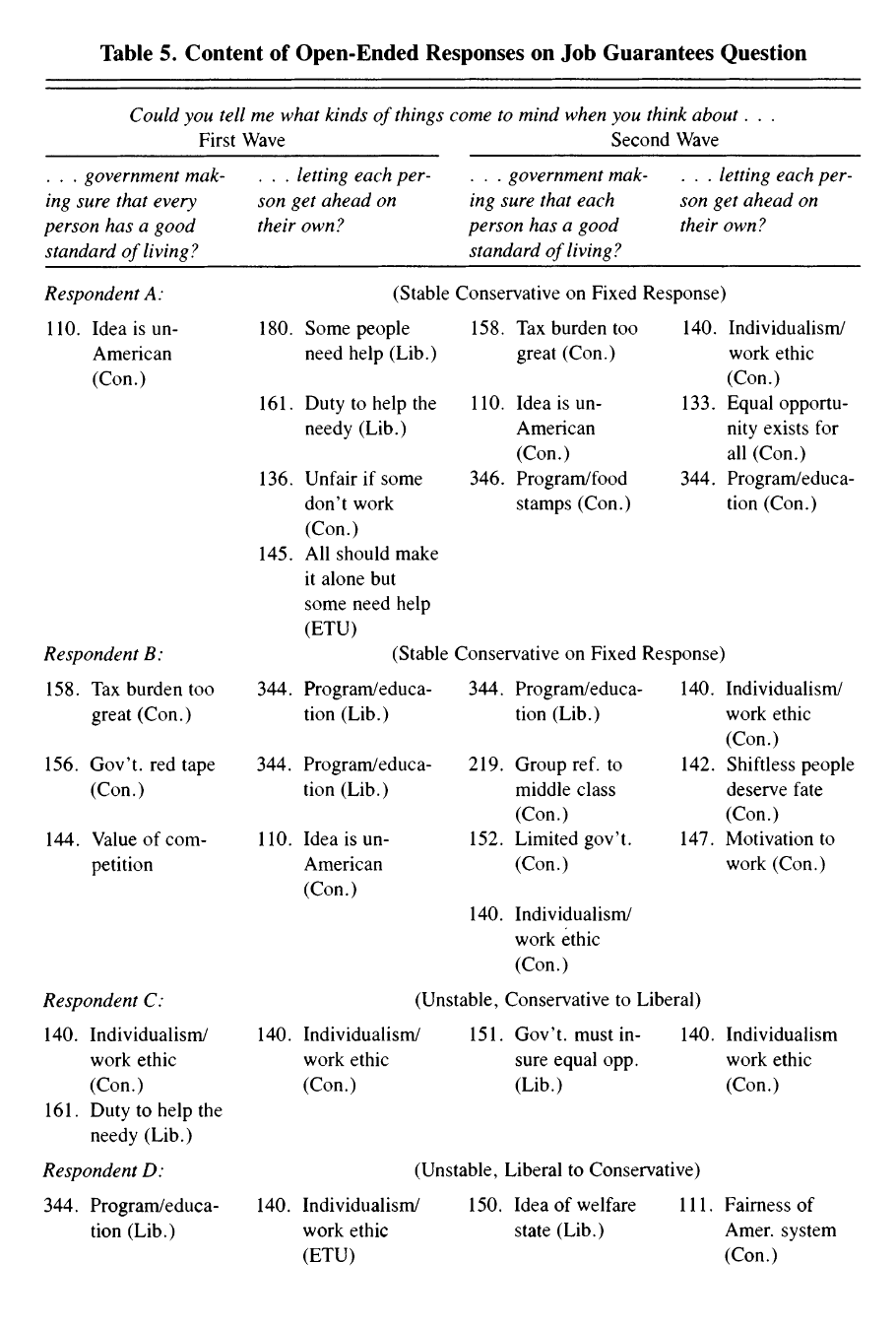
  • People often hold conflicting considerations on issues (Ambivalence)
  • Total considerations increases with political knowledge (Reception)

  • People form responses from considerations at the top of their head (Response)

  • More consistent considerations = More stable responses (Ambivalence, Response, Resistance)

  • Political awareness moderates the effect of survey form

People often hold conflicting considerations on issues

People often hold conflicting considerations on issues

Total considerations increases with political knowledge
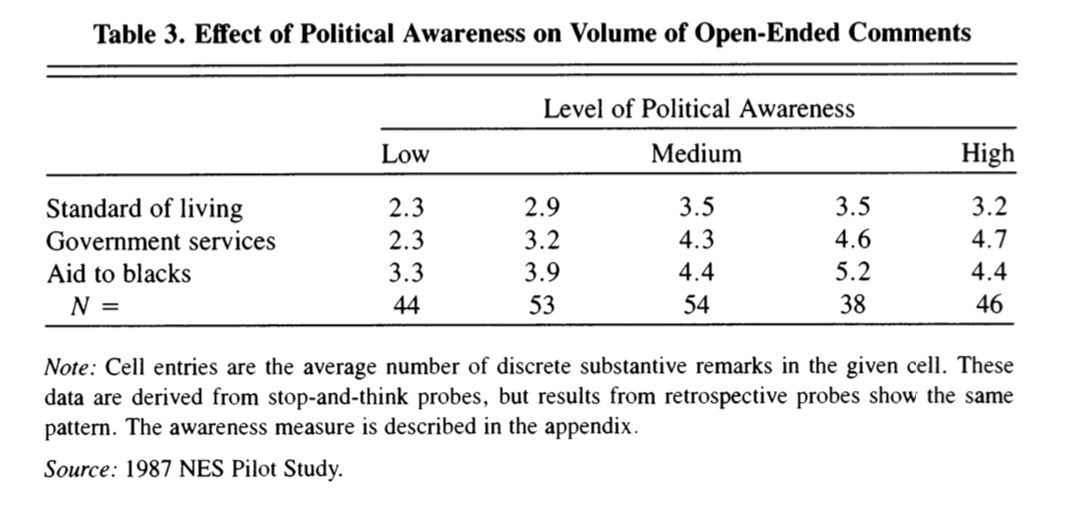
Total considerations increases with political knowledge

People form responses from considerations at the top of their head
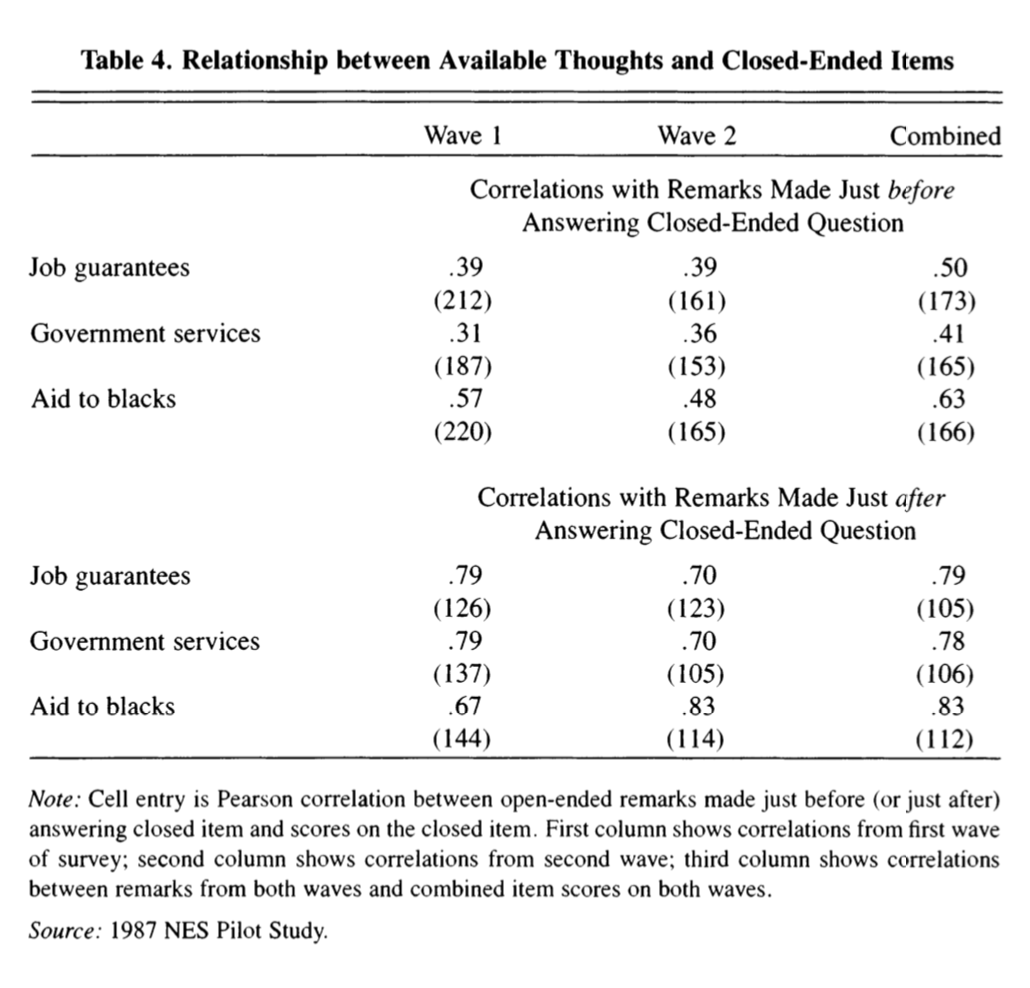
People form responses from considerations at the top of their head

More consistent considerations = More stable responses
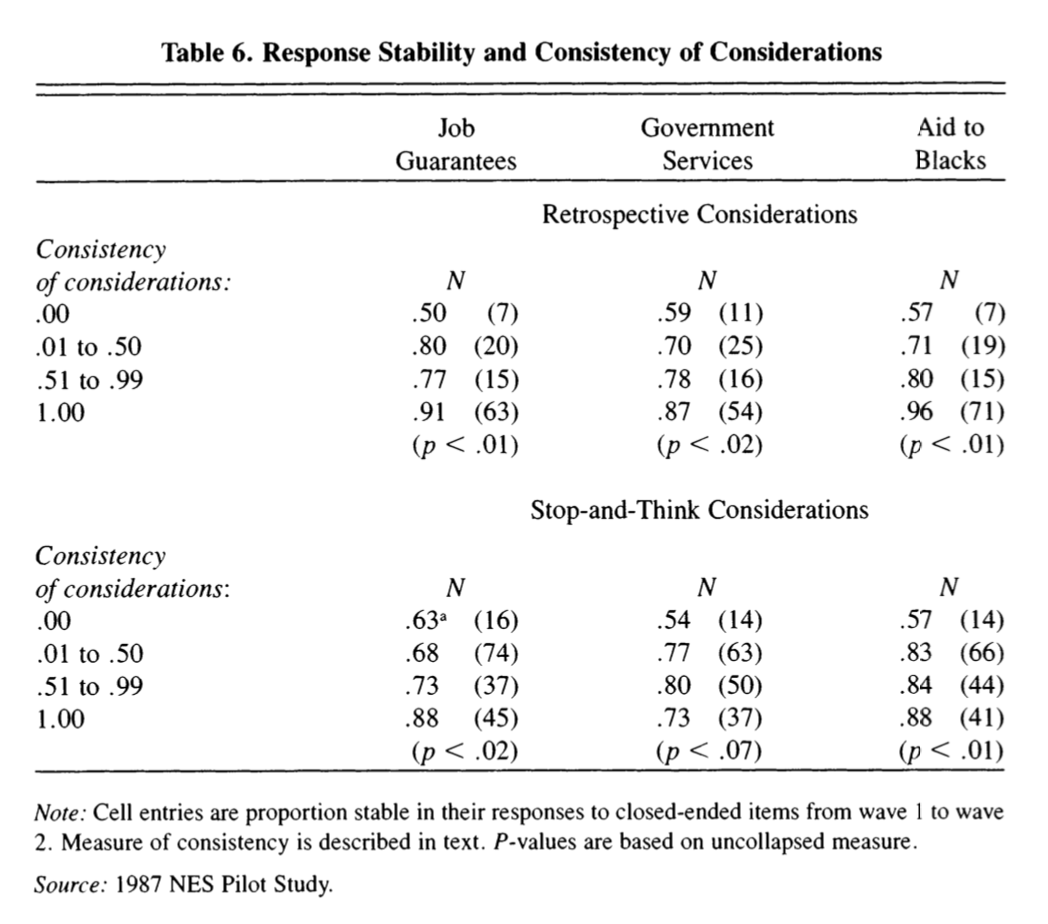
More consistent considerations = More stable responses

Political awareness moderates the effect of survey form
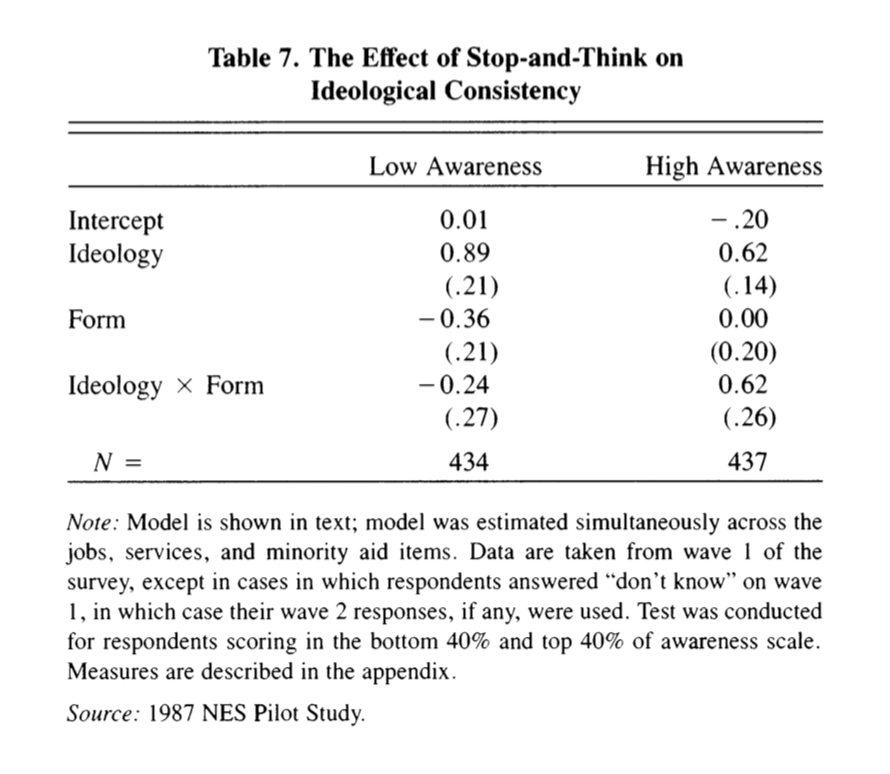
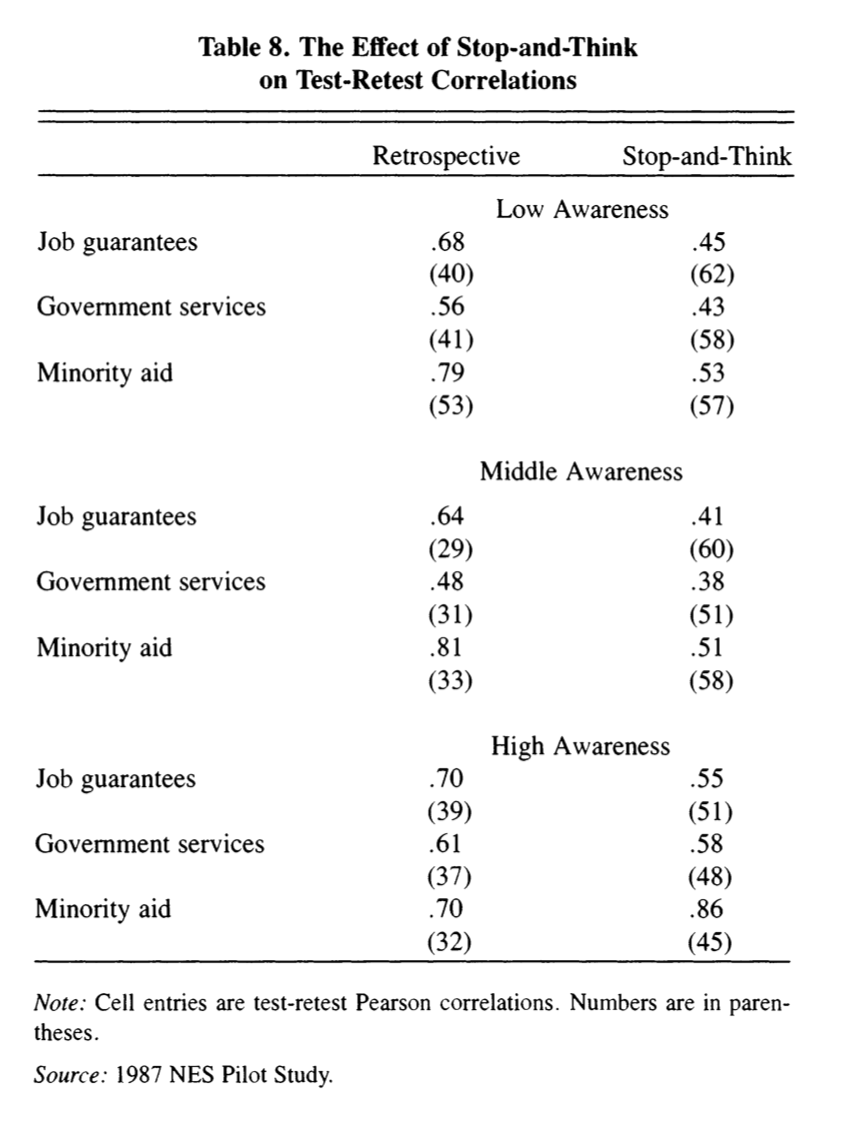
Political awareness moderates the effect of survey form

Summary of the results

  • Unstable attitudes reflect underlying ambivalence

  • Describe attitudes as the result of a probabilistic search reflecting:

    • Effects of ideas recently made salient
    • Effects of thought on attitude reports

What are the conclusions

  • As we’ll see, the analyses here provide the foundation for the RAS model of mass opinion

    • Elite driven

    • Individuals in context

    • But perhaps ignores the role of groups and issues

Receive-Accept-Sample

What’s the theoretical framework

  • Zaller and Feldman’s (1992) framework provide the microfoundations for the Receive-Accept-Sample model of mass opinion developed by Zaller (1992)

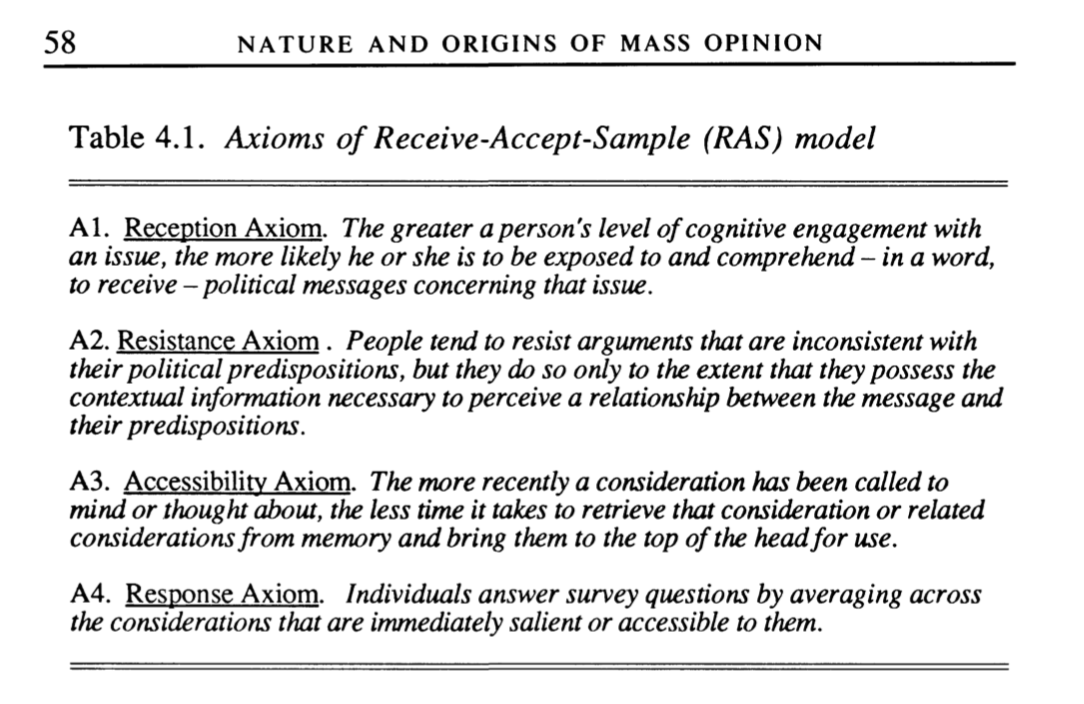
Four Axioms of RAS

The RAS Model:

Opinion statements, are the outcome of a process in which:

  • People receive new information

  • Decide whether to accept it based on predispositions, prior considerations, contextual knowledge

  • Sample at the moment of answering questions by averaging across considerations

\[Pr(Liberal)= \frac{L}{L+C}\]

  • “The probability of a liberal response equals the proportion of accessible considerations that are liberal.”

Implications of the Model

  • People are often ambivalent on issues

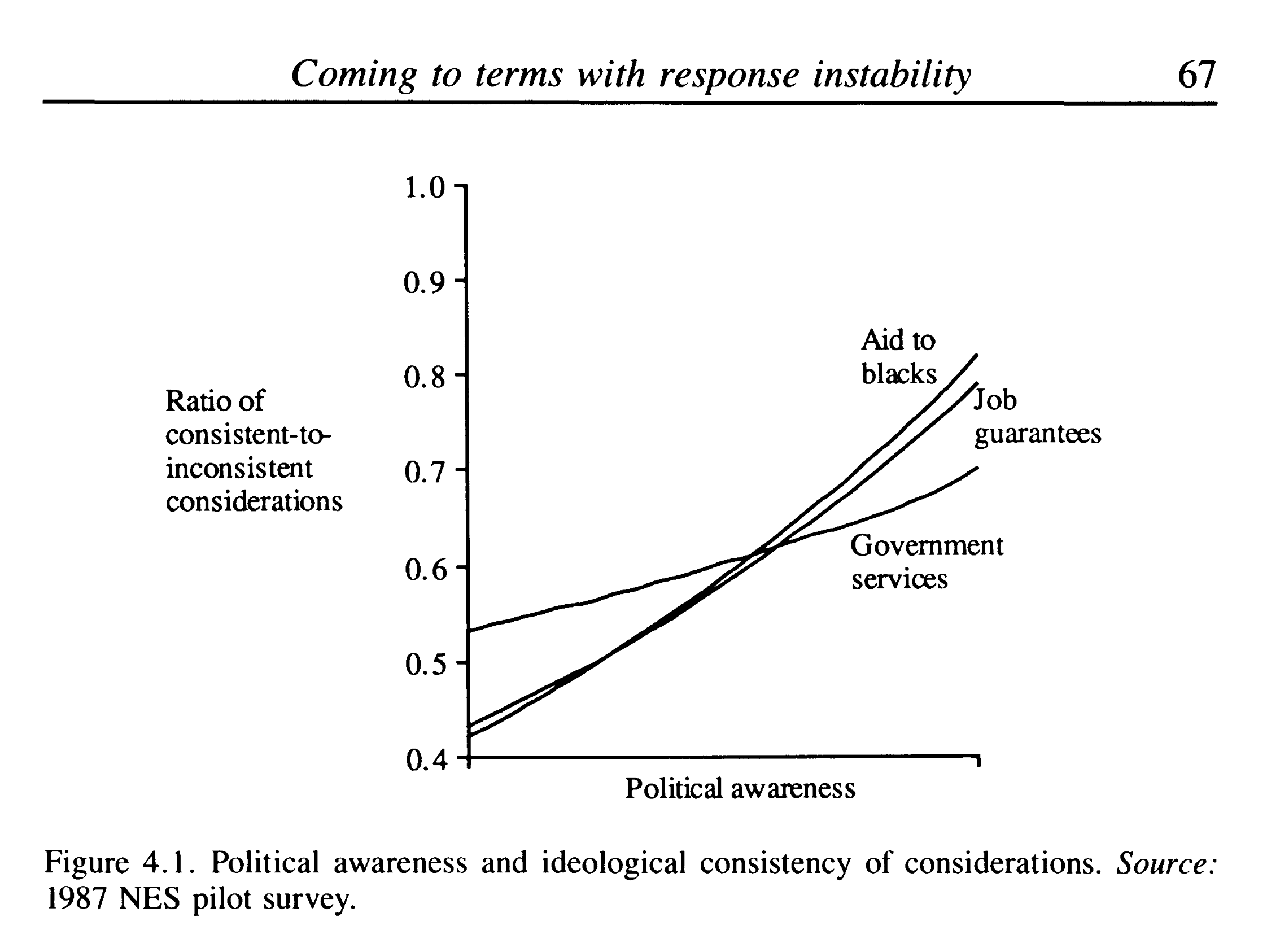
  • Ambivalence is a function of political awareness

  • Response effects reflect changes in the accessibility of different considerations

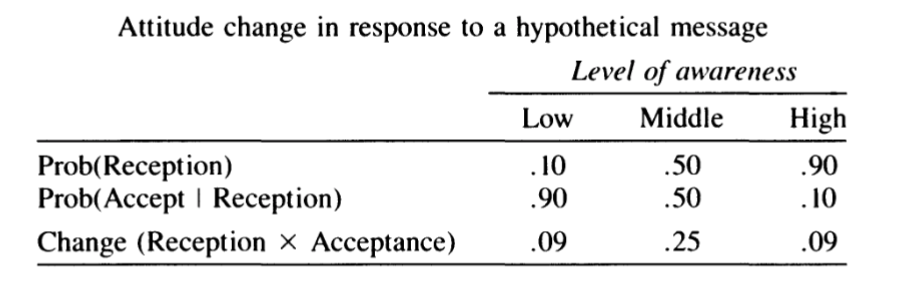
  • Persuasion depends on both reception and acceptance

  • The flow of information matters (one-sided vs two-sided)

People are often ambivalent on issues

  • Politics is complex

  • People are often aware of arguments for and against particular issues
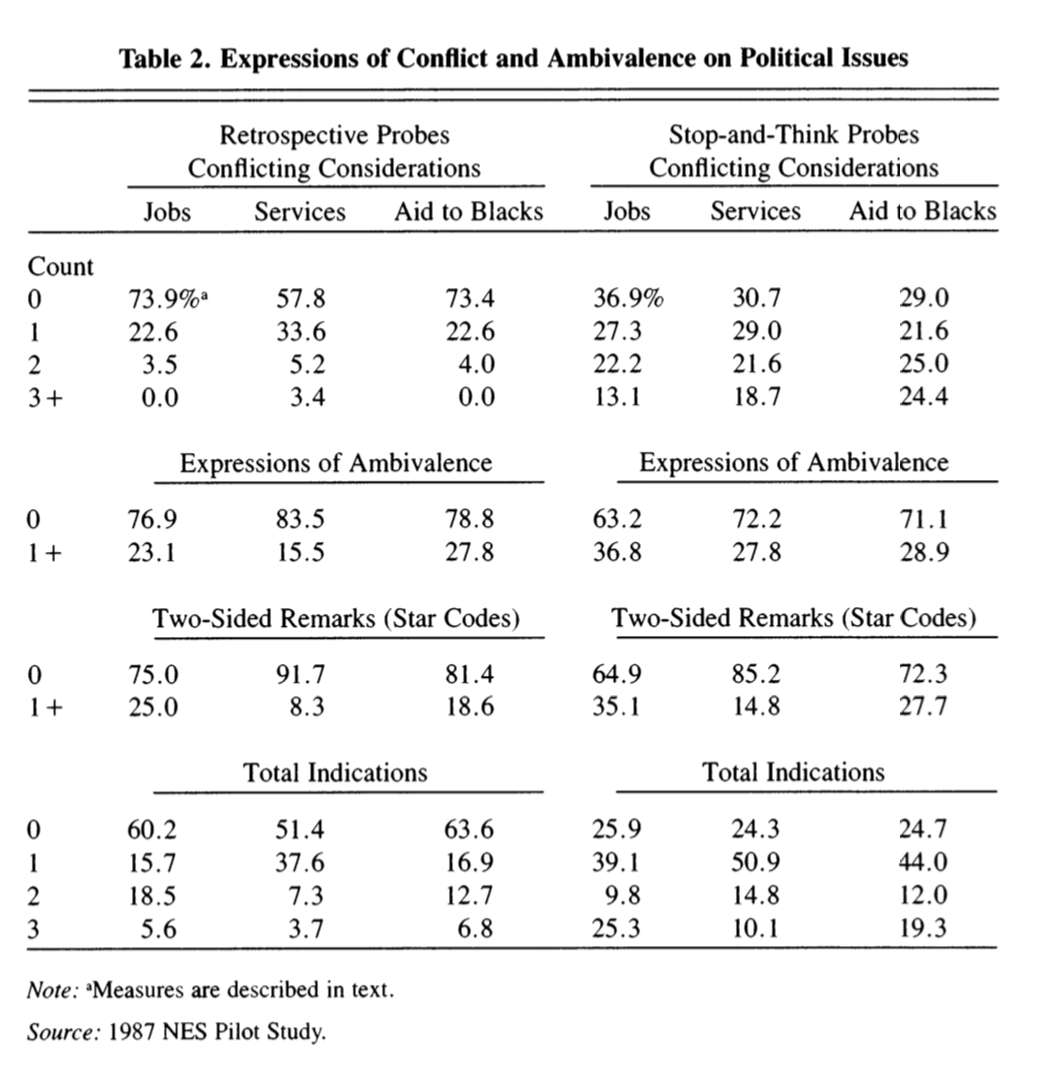
Ambivalence is a function of political awareness

  • The politically aware encounter more information but accept less

  • The political unaware encounter less, but may reject more inconsistently
Response effects

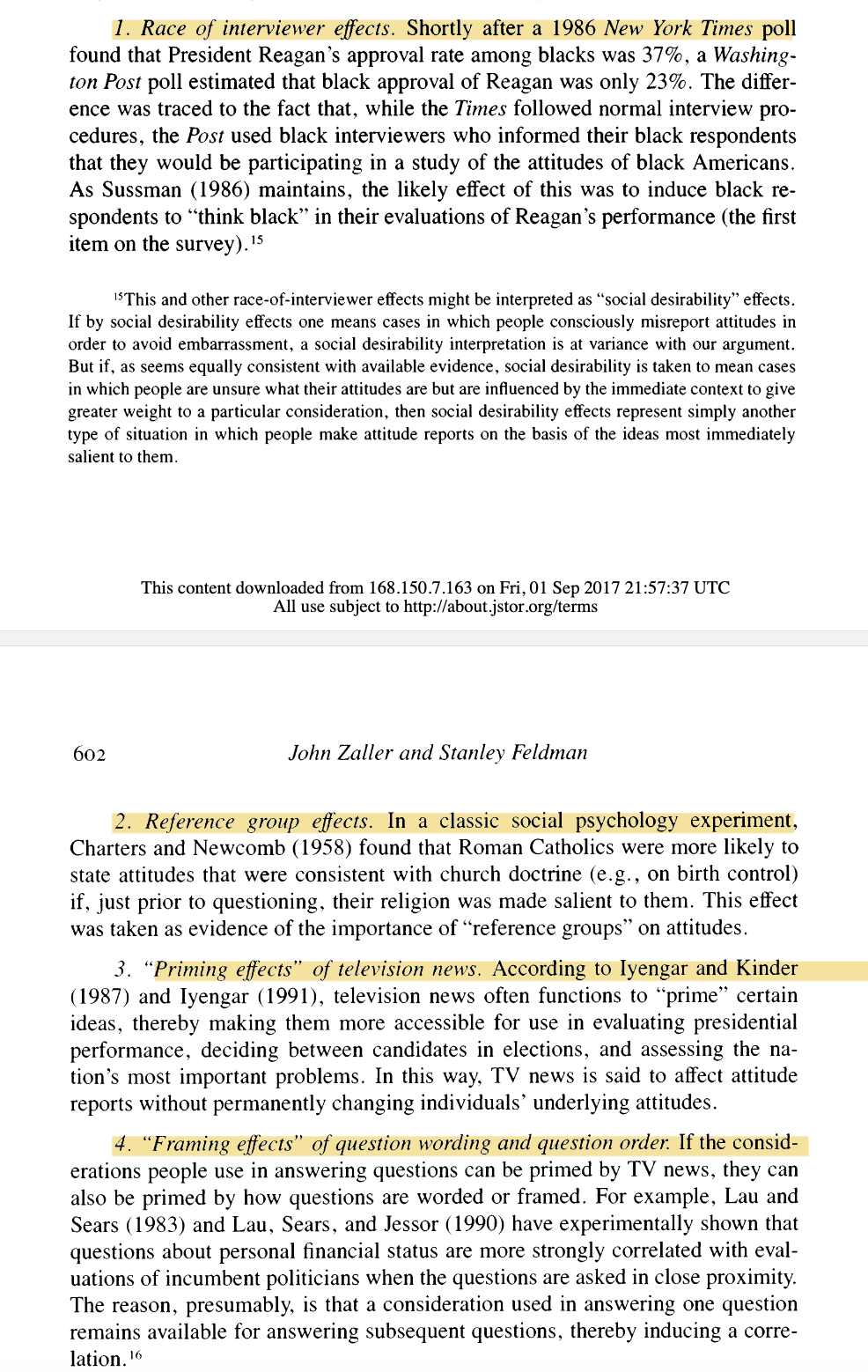
The accessibility axiom is consistent with “response effects” like:

  • Race of interviewer effects

  • Question order effects

  • Question wording effects

Each alter the saliency or accessibility of different considerations

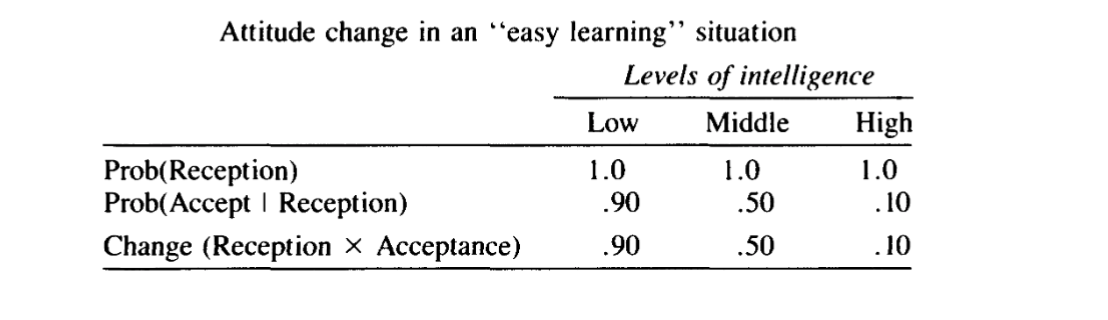
Persuasion depends on both reception and acceptance

\[Pr(Change) = Pr(Reception)\times Pr(Acceptance|Reception)\]
Hard vs Easy Learning
The flow of information matters
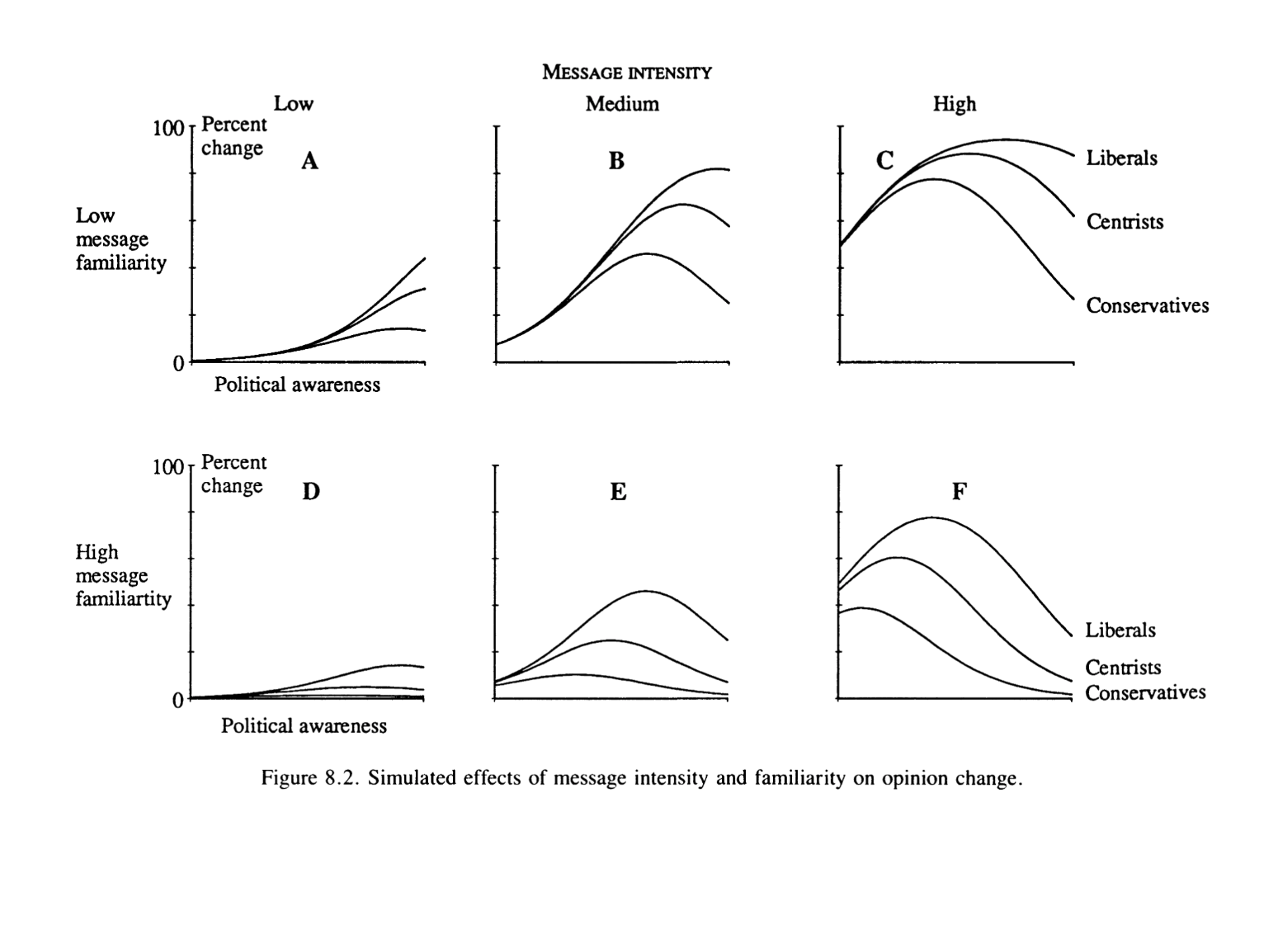
  • RAS is a largely a top-down model, where people draw considerations from elite discourse.

  • RAS predicts change when the flow of information changes

  • The nature of changes should differ based

    • Characteristics of individuals (political sophistication)
    • The nature of information flow (one-sided vs two-sided)

The flow of information matters

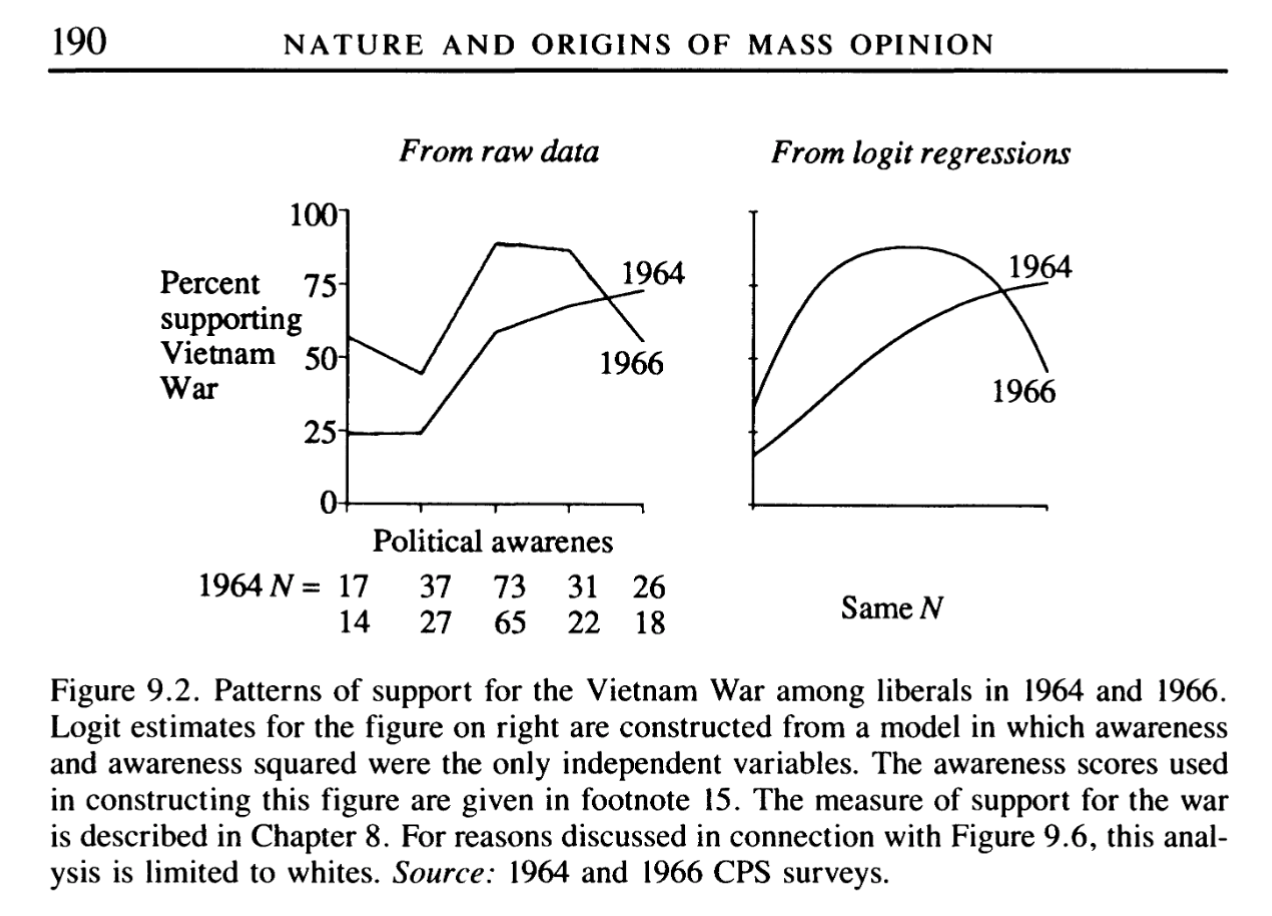
Changes in the Information Flow
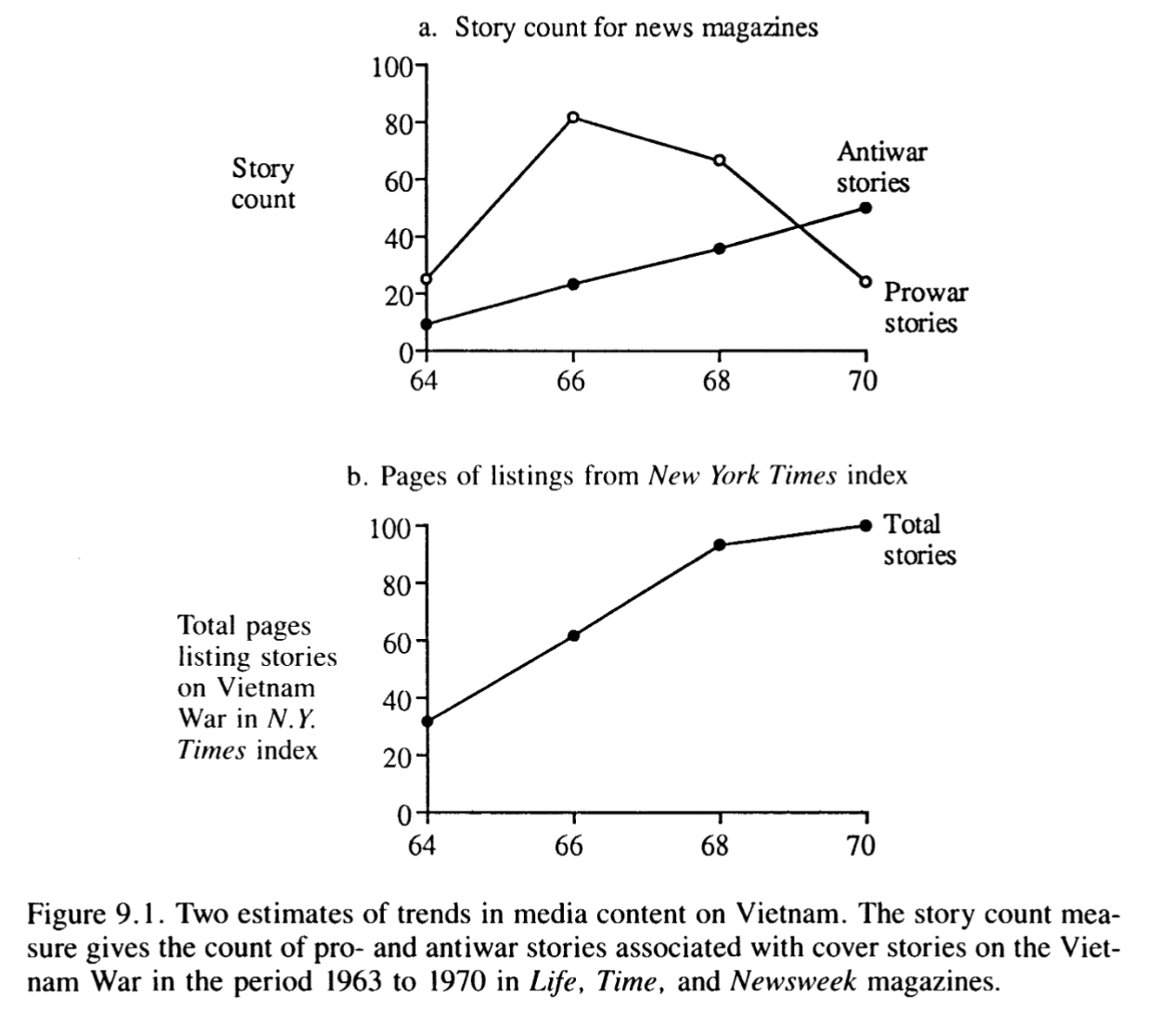
Lead to Changes in Attitudes about Vietnam War
Summary: The Nature and Origins of Mass Opinion

Zaller (1992) articulate’s the Receive-Accept-Sample model of mass opinion

  • People receive information from the world
  • Decide whether to accept this information into their store of considerations
  • Form attitudes by sampling from their available considerations

Summary: The Nature and Origins of Mass Opinion

The RAS model implies that

  • People are often ambivalent on issues

    • Possess competing considerations on issues
  • Ambivalence is a function of political awareness

    • Low awareness: Few considerations
    • Moderate awareness: Most ambivalence
    • High awareness: Structured and consistent
  • Response effects reflect changes in the accessibility of different considerations

  • Persuasion depends on both reception and acceptance

    • Political awareness increases reception, but decreases acceptance
  • The flow of information matters

    • One sided vs Two sided

Dual Process Models of Cognition

Beyond Receive-Accept-Sample

  • RAS is a “useful” model
    • It appears to explain a lot with relatively few assumptions
  • RAS is a “simple” model
    • Lot’s of mechanisms left unexplained
  • RAS is a survey response and opinion formation
  • Taber and Lodge make deeper claims about cognition, motivation, and evaluation

Dual Process Models of Cognition

Dual process models distinguish between systems of cognition that are fast and slow

  • System 1: Fast, Automatic, sub/pre-conscious, parallel, long-term memory
  • System 2: Slow, Deliberate, conscious, serial, working memory
  • T&L: In politics, System 2 is often downstream of and justifying System 1 (rationalization)

The Driving Analogy

Taber and Lodge (2013)

Taber and Lodge (2013) use this dual process framework to argue citizens

  • Rationalizing, not rational
  • Influenced by subtle/implicit cues
  • Rely on a Likeability Heuristic (System 1)

Political judgment is driven by fast affective processes that bias what becomes “thinkable”; conscious reasoning often defends the result.
Taber and Lodge (2013)

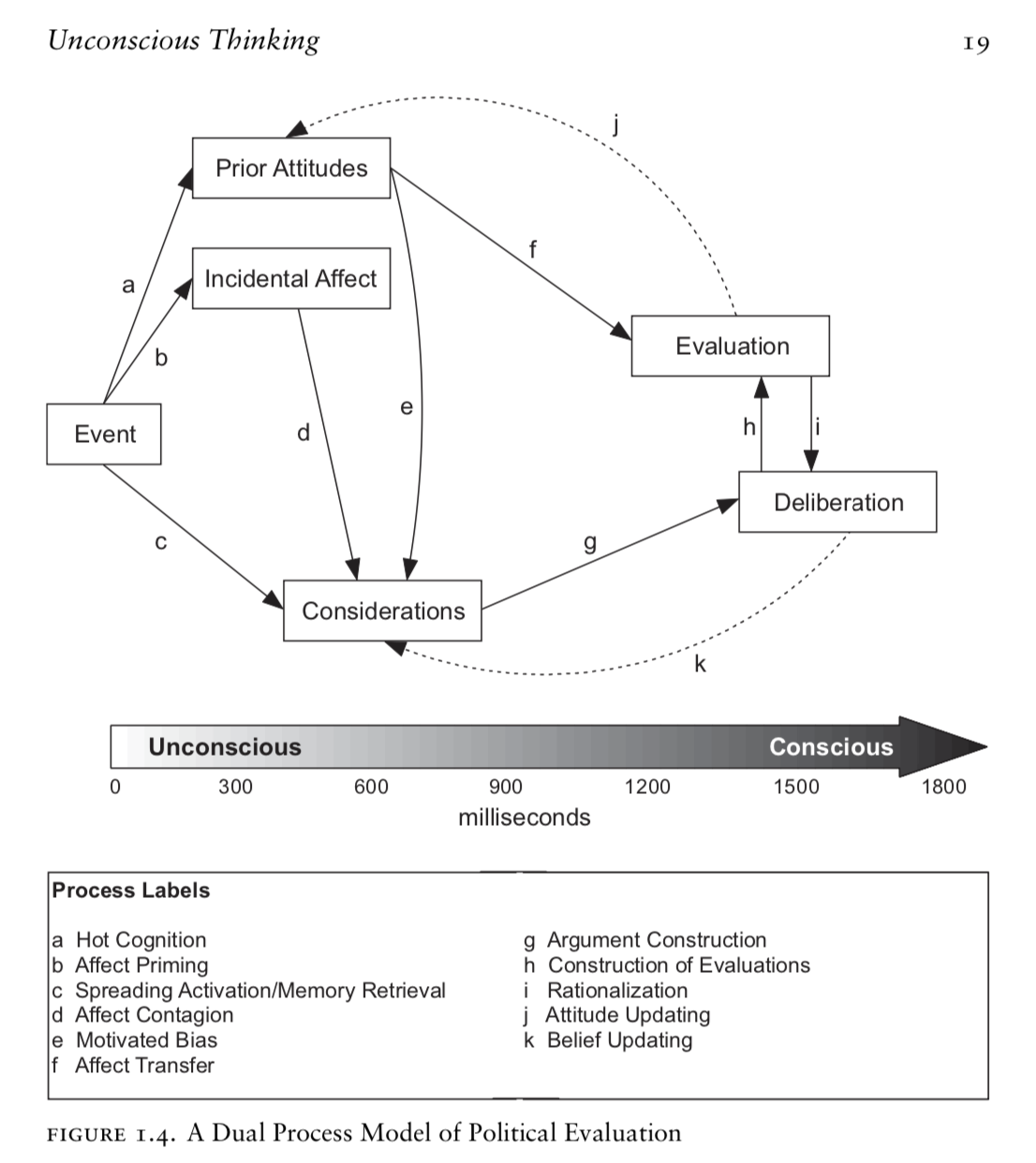
The fundamental assumption driving our model is that both affective and cognitive reactions to external and internal events are triggered unconsciously, followed spontaneously by the spreading of activation through associative pathways which link thoughts to feelings, so that very early events, even those that remain invisible to conscious awareness, set the direction for all subsequent processing (p. 18)

Taber and Lodge (2013)

The fundamental assumption driving our model is that both affective and cognitive reactions to external and internal events are triggered unconsciously, followed spontaneously by the spreading of activation through associative pathways which link thoughts to feelings, so that very early events, even those that remain invisible to conscious awareness, set the direction for all subsequent processing (p. 18)

The Model

The Model

  1. Affect first (hot cognition)

  2. Affect biases retrieval (contagion + motivated bias)

  3. Deliberation often rationalizes (evaluation + deliberation)

Key Concepts:

  • Early/implicit: hot cognition, affect priming, spreading activation

  • Biasing mechanisms: affect contagion, motivated bias, affect transfer

  • Downstream/explicit: argument construction, deliberation, rationalization

  • Dynamics: attitude updating, belief updating

Hypotheses

  • Hot cognition: all political objects have positive or negative valence

  • Automaticity: attitudes and behavior can be influenced by information processes that occur outside conscious awareness

  • Affect transfer: affective states and primes can influence current thoughts

  • Affect contagion: affective states and primes can influence information retrieval

  • Motivated reasoning prior affect will bias attention and processing of information toward those prior beliefs

Seven Postulates (p.34)

As you read/review this article, try to find examples/evidence of the following:

  • Automaticity:

  • Hot cognition:

  • Somatic embodiment:

  • Primacy of affect

  • Online updating

  • Affect transfer

  • Affect contagion

Hot Cognition

  • Automatic feelings associated with an event or object

  • Positive or negative

  • Preceed and shape more “rational” deliberative thoughts

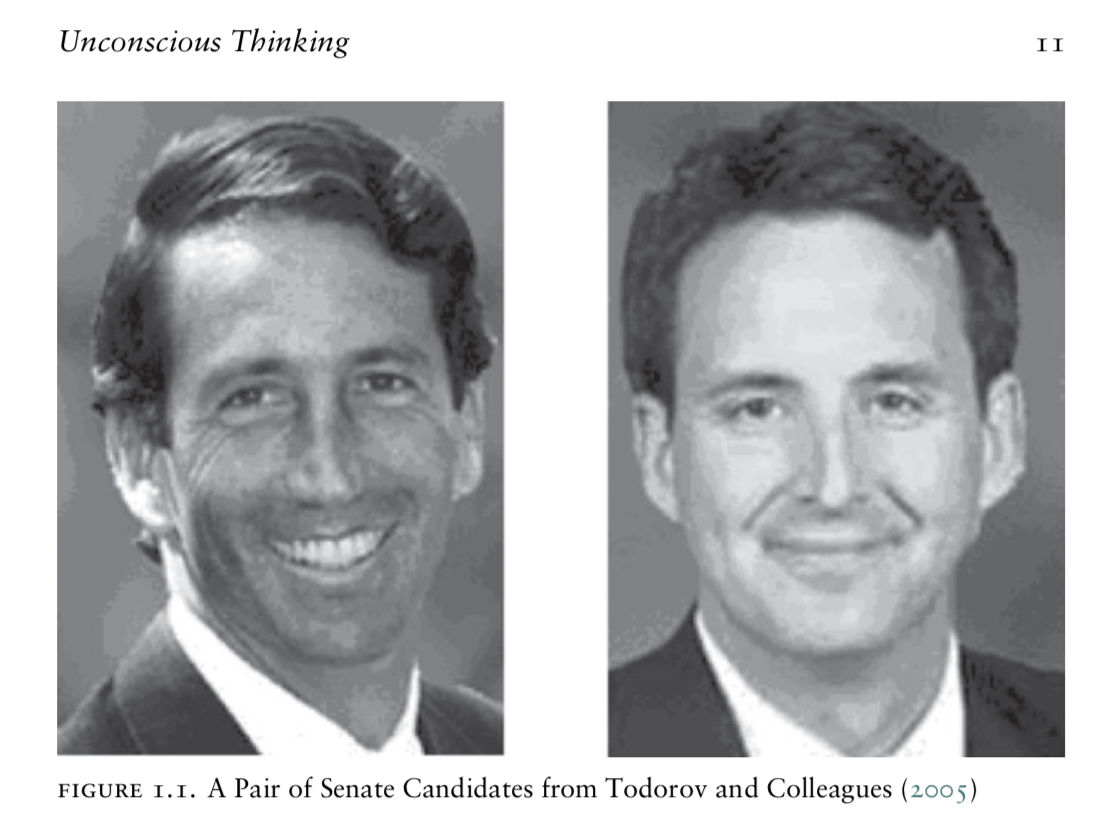
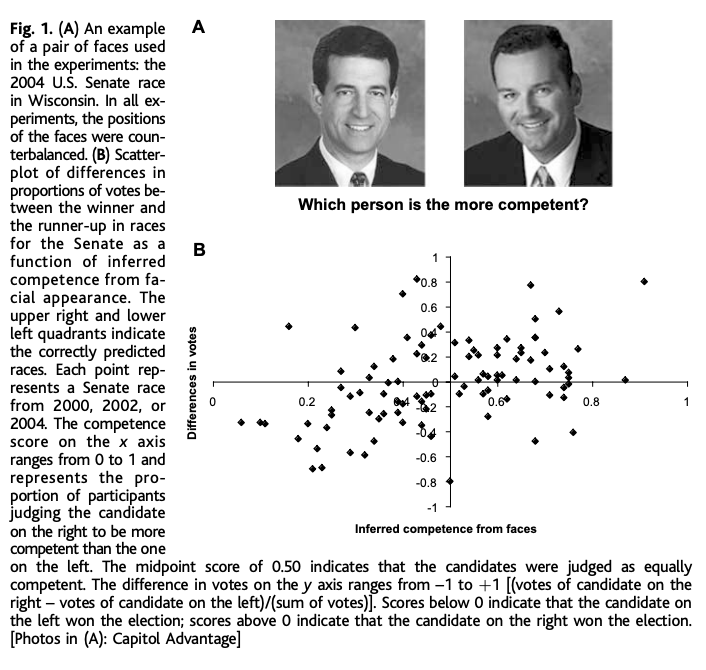
Who you got

Todorov et al. 2005

inferences of competence based solely on facial appearance predicted the outcomes of U.S. congressional elections better than chance
Spreading Activation

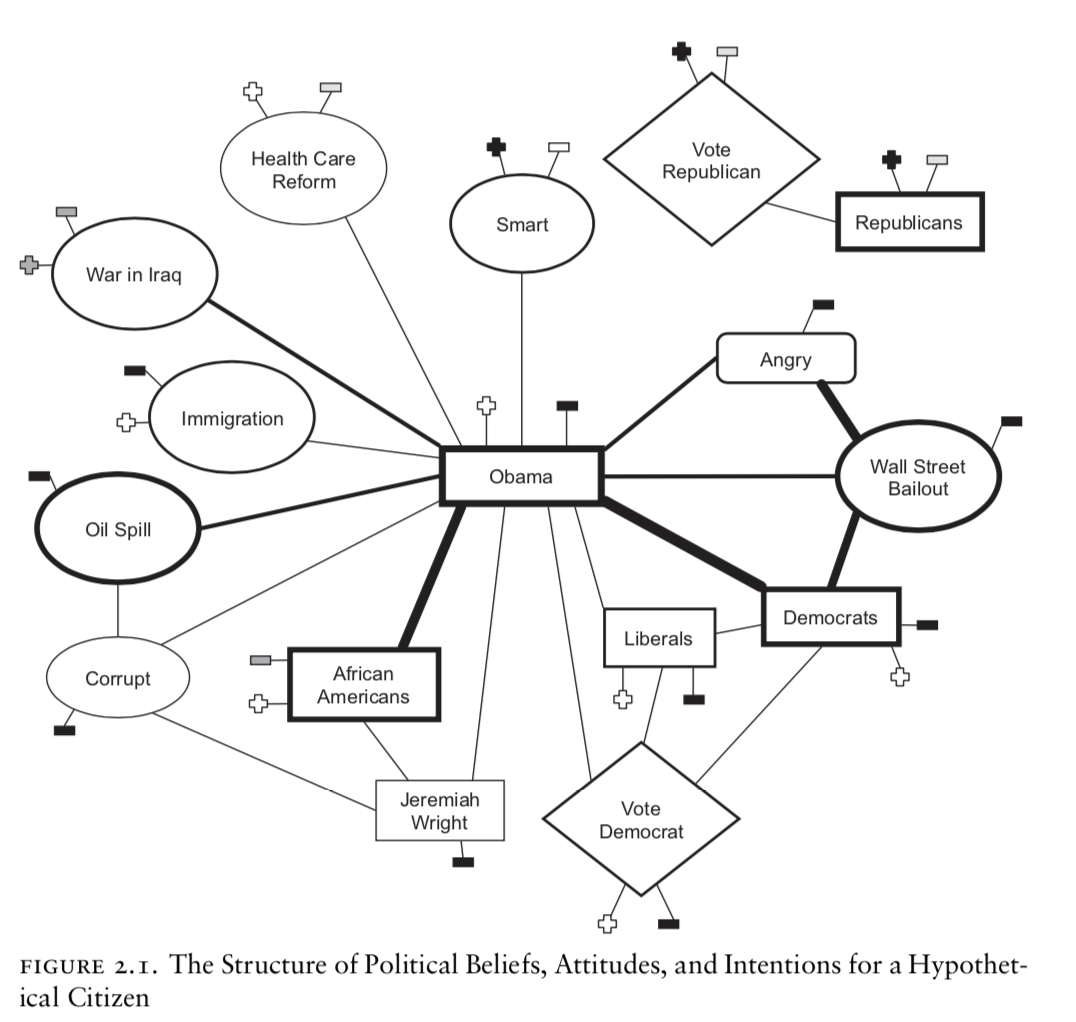
  • What comes to mind when you think of former president Barack Obama?

Spreading Activation

  • Illustration of hypothetical, white, Republican voter’s beliefs about Obama

  • When think of Obama, these additional connections are activated

  • The stronger the connections, more likely they are to reach consciousness
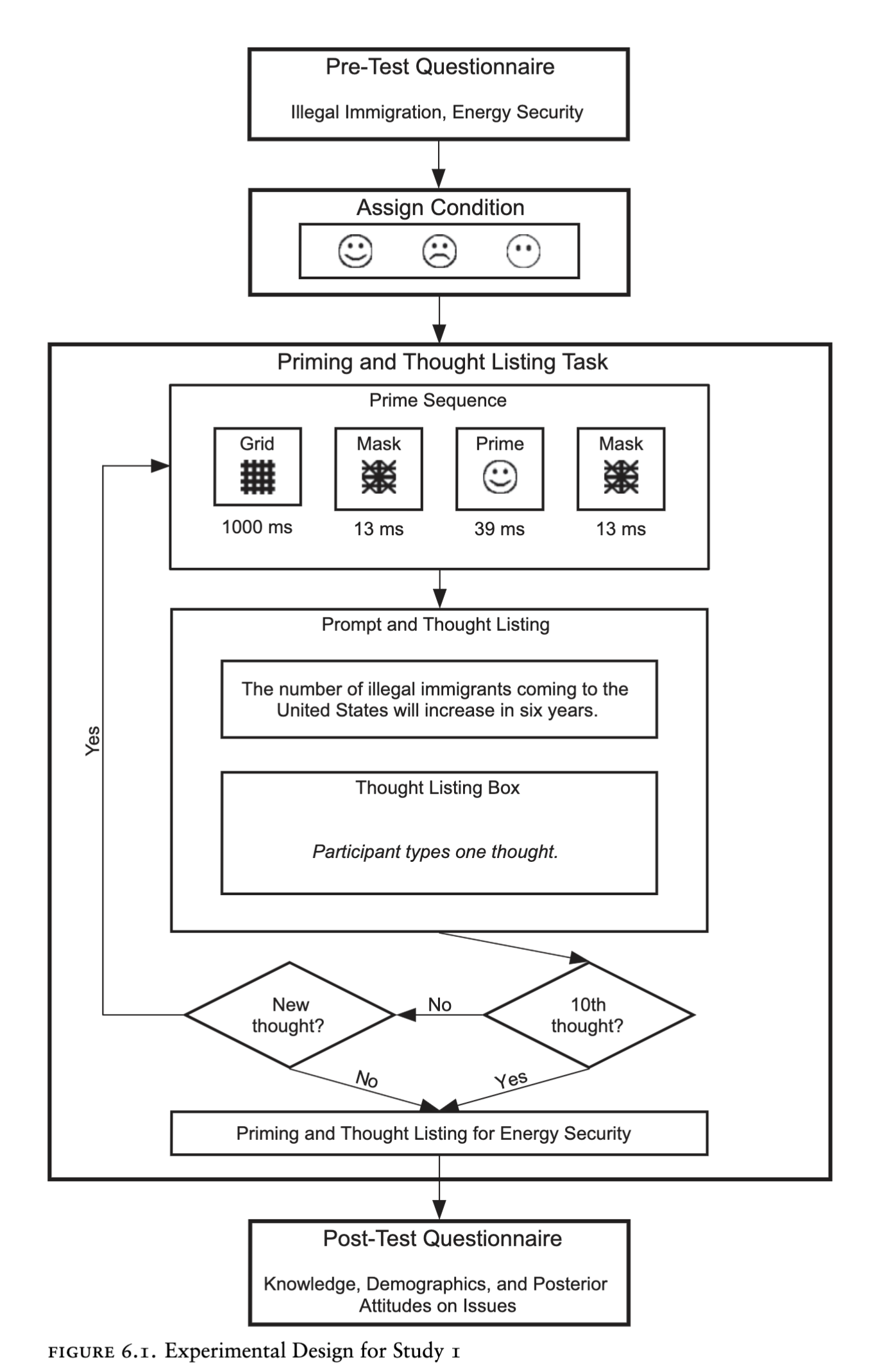
Affect Transfer, Priming and Contagion

Affect Contagion
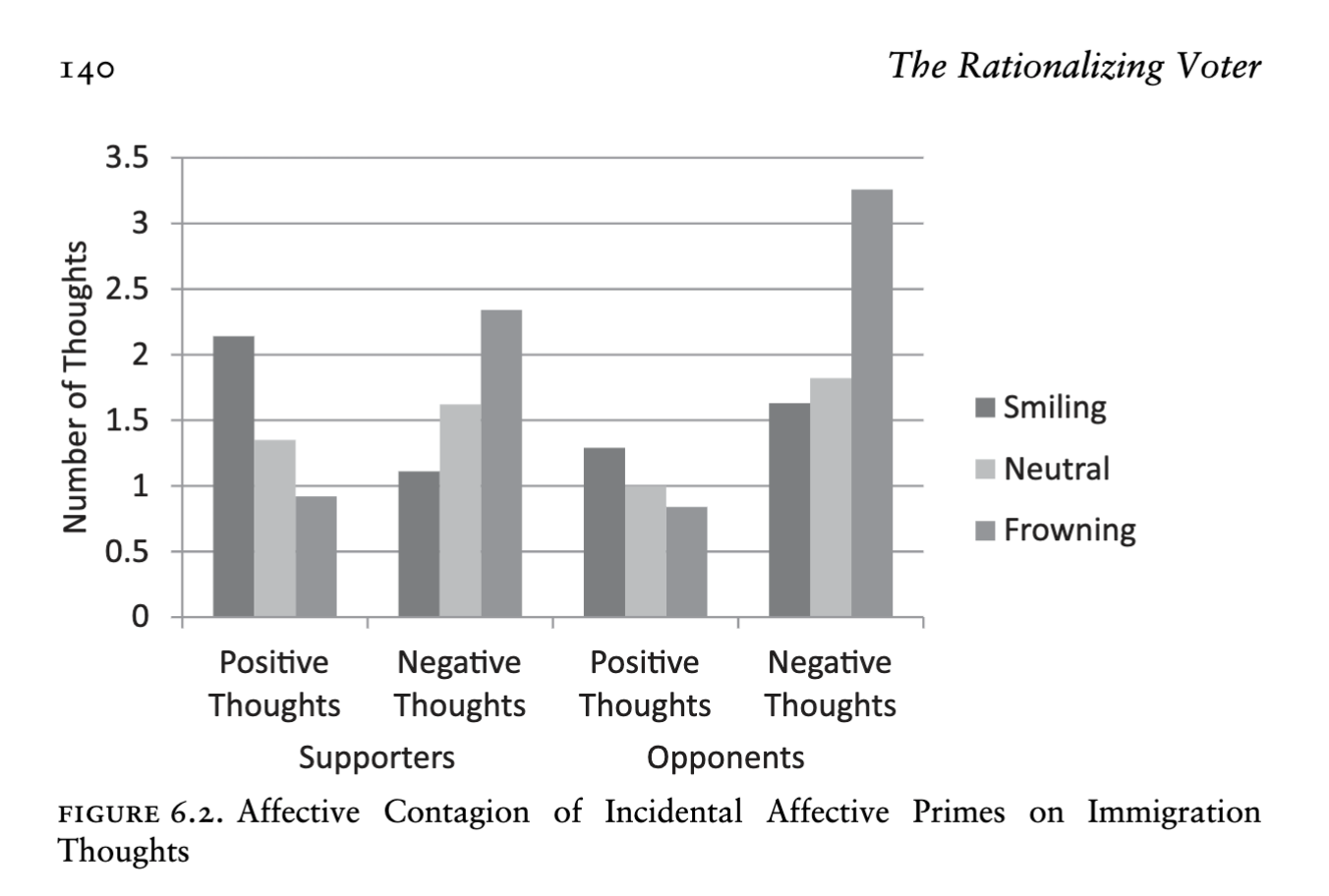
An affective contagion effect, such that an unnoticed positive prime promotes positive thoughts and inhibits negative thoughts, while an unnoticed negative prime promotes negative and inhibits positive thoughts. (p. 136)

Affect Contagion

Affect Contagion

Simple cartoon faces flashed outside the conscious awareness of experimental subjects significantly and consistently altered their thoughts and considerations on a political issue, with effects greater in size to those of prior attitudes on the issue (p. 142)
Motivated Reasoning

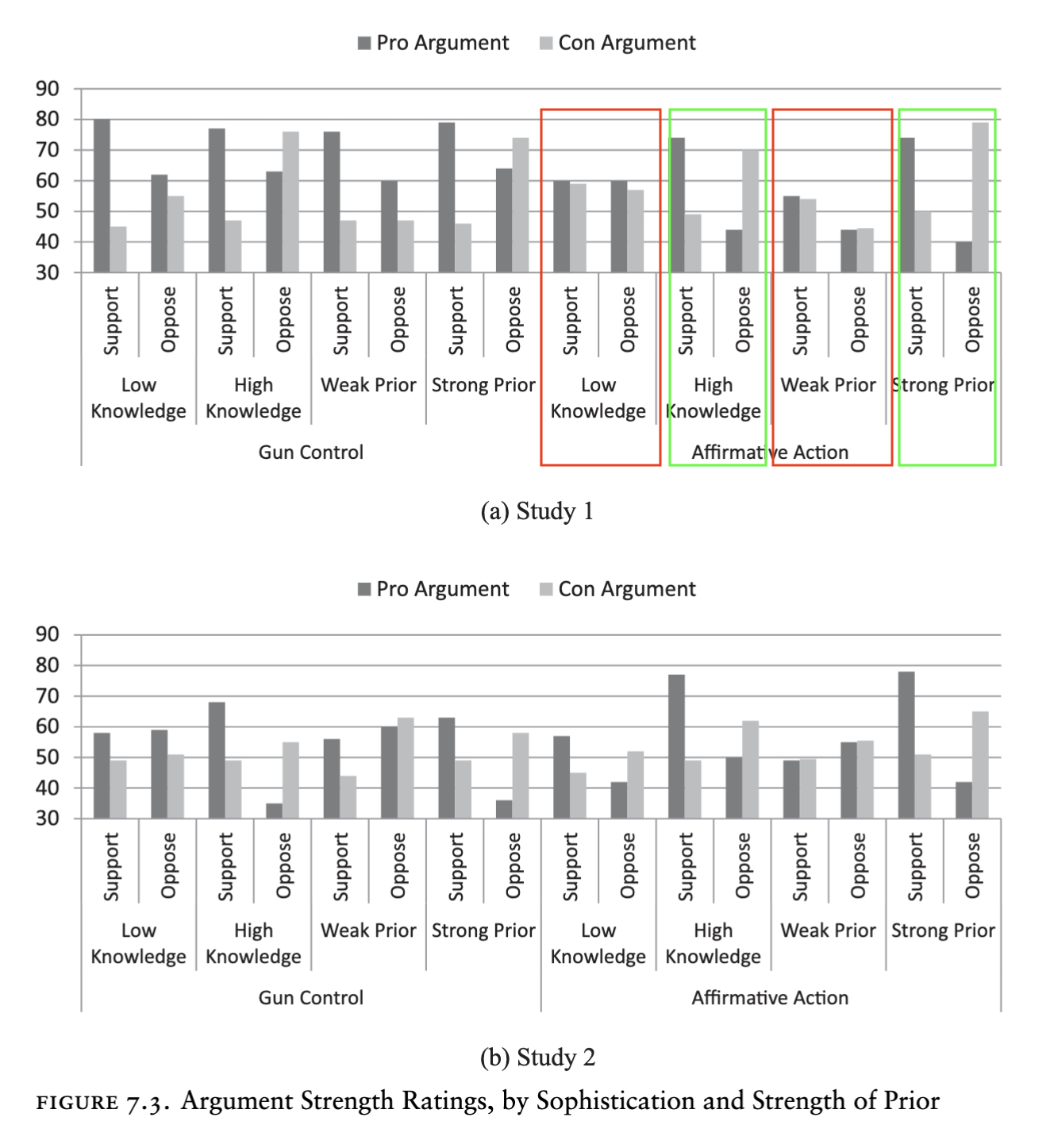
  • Ask participants to rate the strength of equivalent arguments

  • People with strong priors, greater knowledge, rate congruent arguments as stronger because retrieval/counterarguing are affect-biased (disconfirmation / counterarguing).
Taber and Lodge (2013) - The Rationalizing Voter

  • Dual process model of cognition

    • System 1: Fast, automatic, outside consciousness (How they actually make many decisions)

    • System 2: Slow, deliberative, conscious thought (How we think citizens should make political decisions)

  • Affect proceeds and shapes attitudes and behavior

Seven Postulates (p.34)

Information processing is

  • Automaticity: Priming studies

  • Hot cognition: “Thin slice” cadidate evaulations

  • Somatic embodiment: Iowa gambling experiment

  • Primacy of affect fMRI studies showing affect proceeds conscious thought

  • Online updating Candidate evaluation and recall studies

  • Affect transfer “Sunny day” studies

  • Affect contagion Long run consequences of hot cognition and affect transfer

Critiques

  • Implicit vs Explicit attitudes

  • Are priming effects short lived?

    • Are they real?
  • External (and internal validity)

  • Positive/Negative affect vs Discrete Emotions

Retrospective Voting

Overview

  • Retrospective voting reflects an alternative response to problems raised by Converse (1964)

  • Redefine the problem of citizen competence

    • Democracy doesn’t need perfectly informed, ideal citizens
    • Just requires citizens to select competent leaders and sanction bad leaders

Two Models of Retrospective Voting

  • Leadership selection:
    • Select the most competent candidate
  • Sanctioning
    • Punish “bad” candidates who fail to work on citizens behalf

Both models depend on the quality of the information or signal citizens have

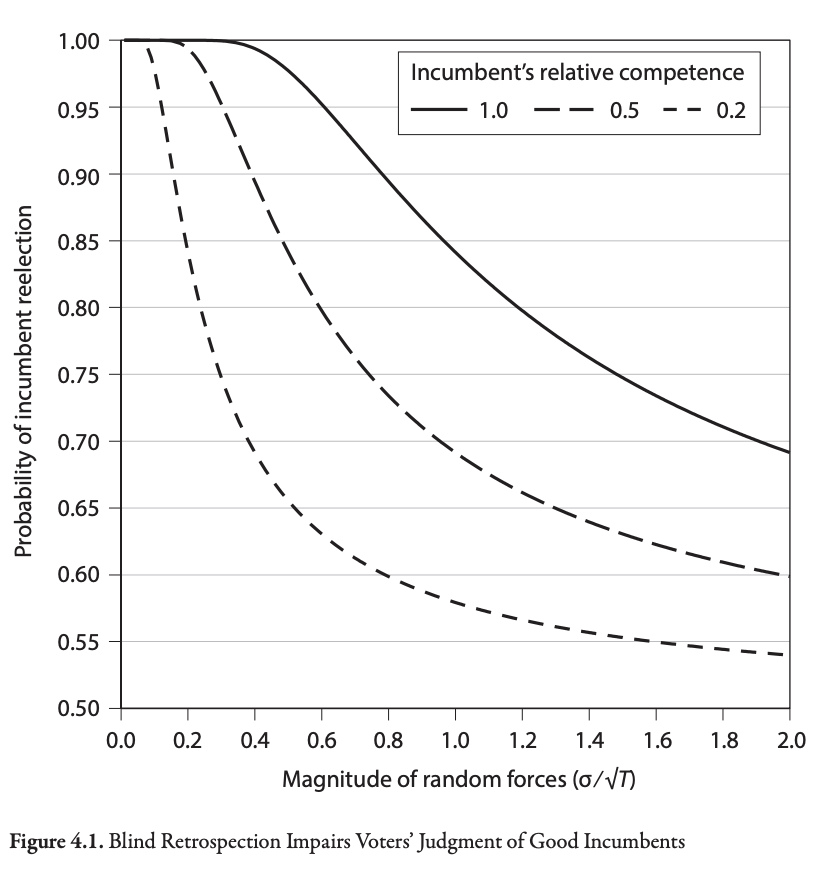
Leadership Selection

As the information environment becomes noisier, it becomes harder to select good leaders
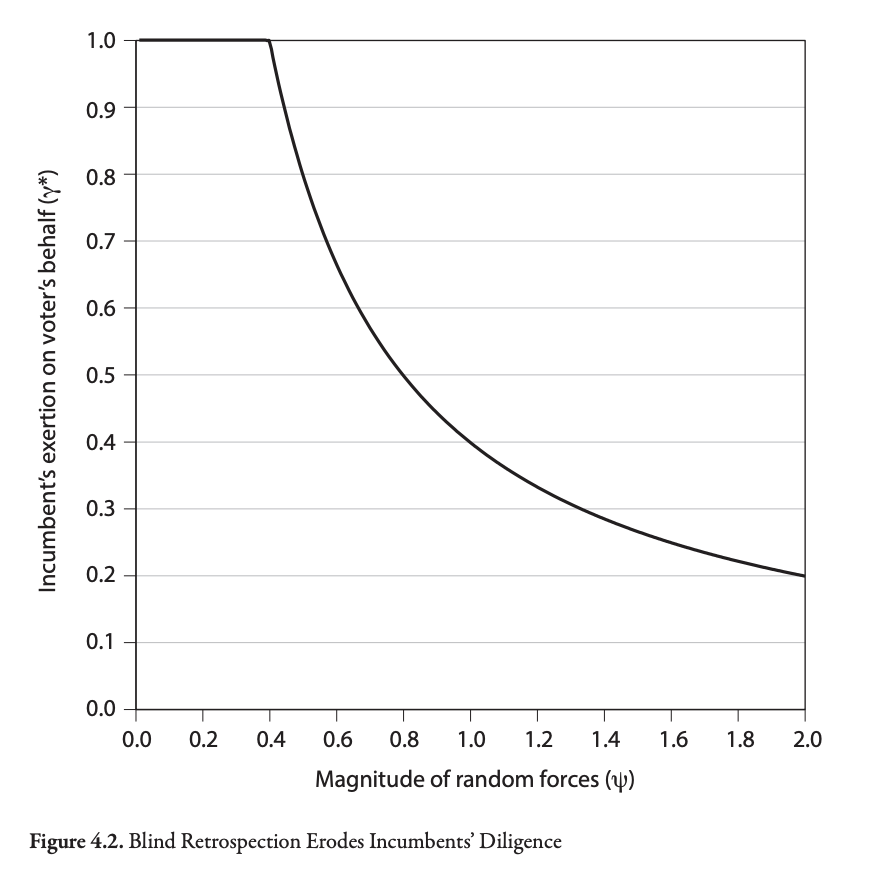
Leadership Sanctioning

As the information environment becomes noisier, it becomes

  • Harder for voters to sanction ineffective leaders

  • Easier for leaders to shirk their duties
Retrospective Voting

So what should people base their retrospective evaluations on?

In order to ascertain whether the incumbents have performed poorly or well, citizens need only calculate the changes in their own welfare. (Fiorina 1981)

Economic Voting

Economic Voting (Fiorina 1978)
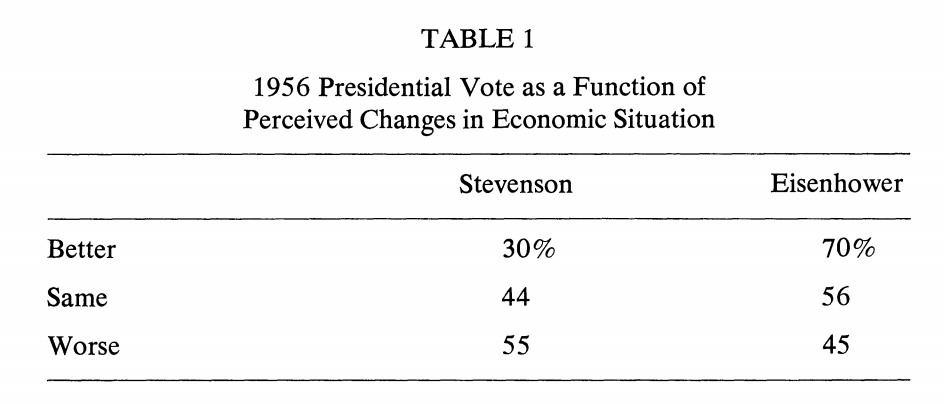
Aggregate Evidence of Retrospective Voting

Debates in Economic Voting

Broad consensus that economic factors matter, but lots of ongoing debates within the field of economic voting:

  • Macro vs Micro | Sociotropic vs Egocentric | National vs Pocketbook

    • Do national or individual economic factors matter?
  • Time horizons | Myopic voters

    • Do voters maintain a “running tally” of long term events or are they overly swayed by recent changes
  • Negative vs positive shocks

    • Negativity bias: weight bad news more heavily than good?
  • Mechanisms and moderators

    • Partisans biases in evaluations of the economy

Achen and Bartel’s Critique of Retrospective Voting

A&B’s critique boils down to two claims:

  1. Voters retrospective capabilities appear haphazard at best
    • Punish politicians for things that are out of their control (Blind Retrospectiion)
    • Ignoring policy failures they could address (e.g. Spanish Influenza)
  2. Voter’s Economic evaluations are:
    • Short sighted
    • Poor predicters of competence
    • Open to Manipulation

Blind Retrospection

Review

Take a moment to review the arguments in Chapter 5. Specifically:

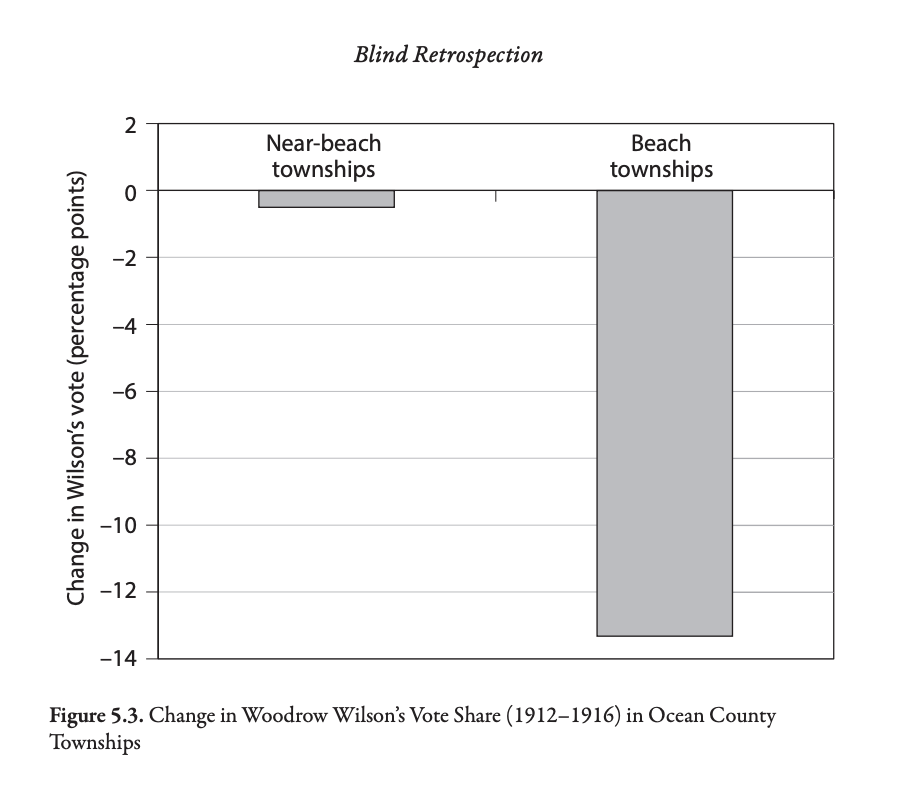
  • Table 5.1 and Figure 5.1 and 5.3

  • Table 5.2 and Figure 5.4

Shark Attacks and Blind Retrospection
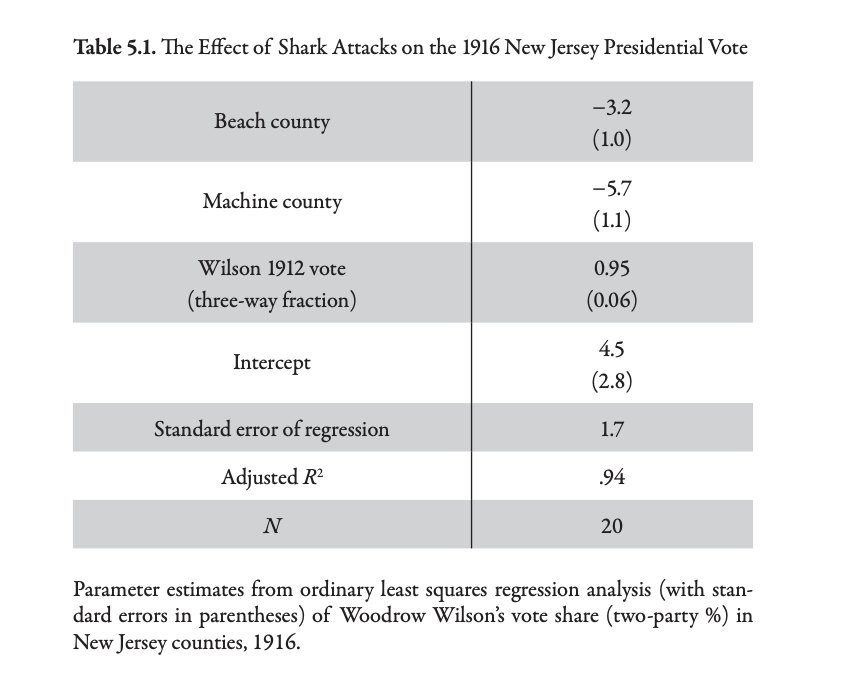
Shark Attacks and Blind Retrospection
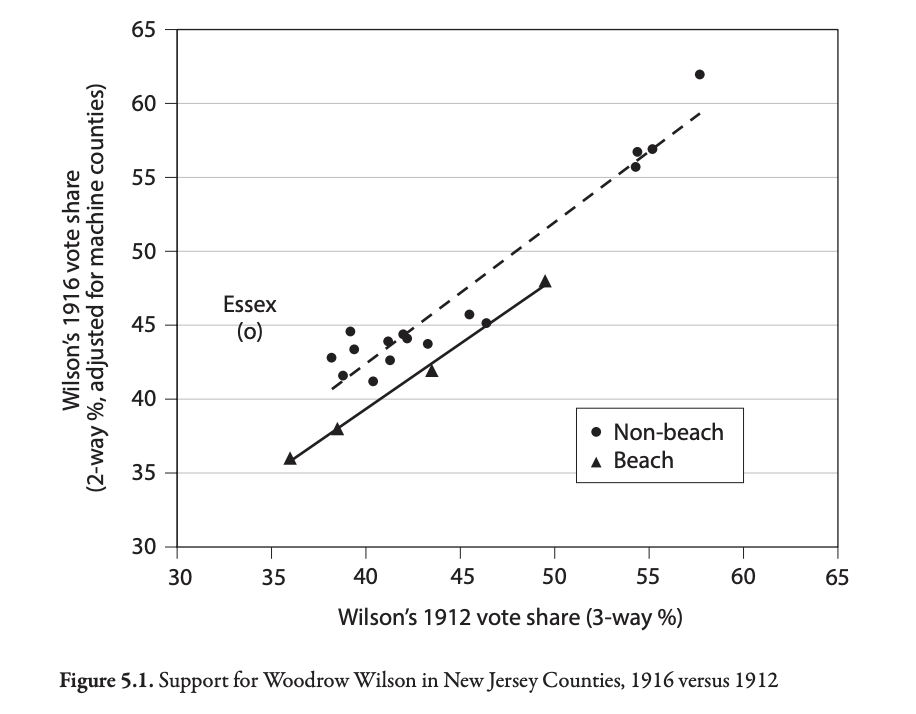
Shark Attacks and Blind Retrospection
Droughts and Blind Retrospection
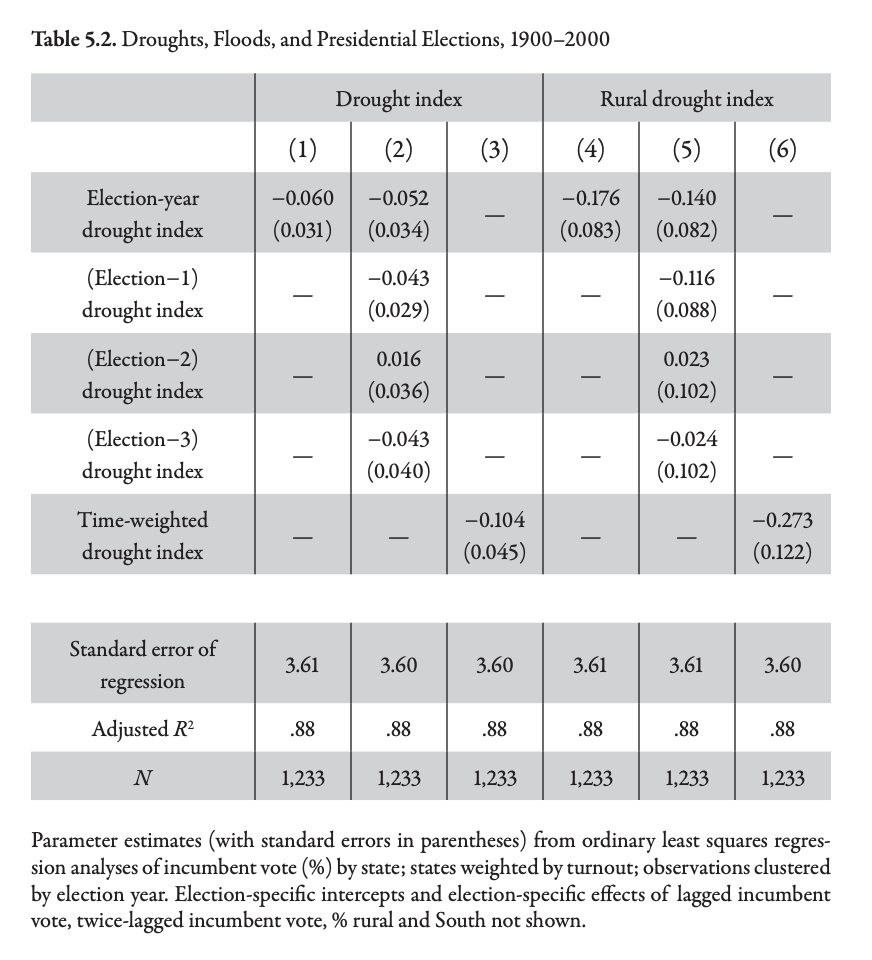
Droughts and Blind Retrospection
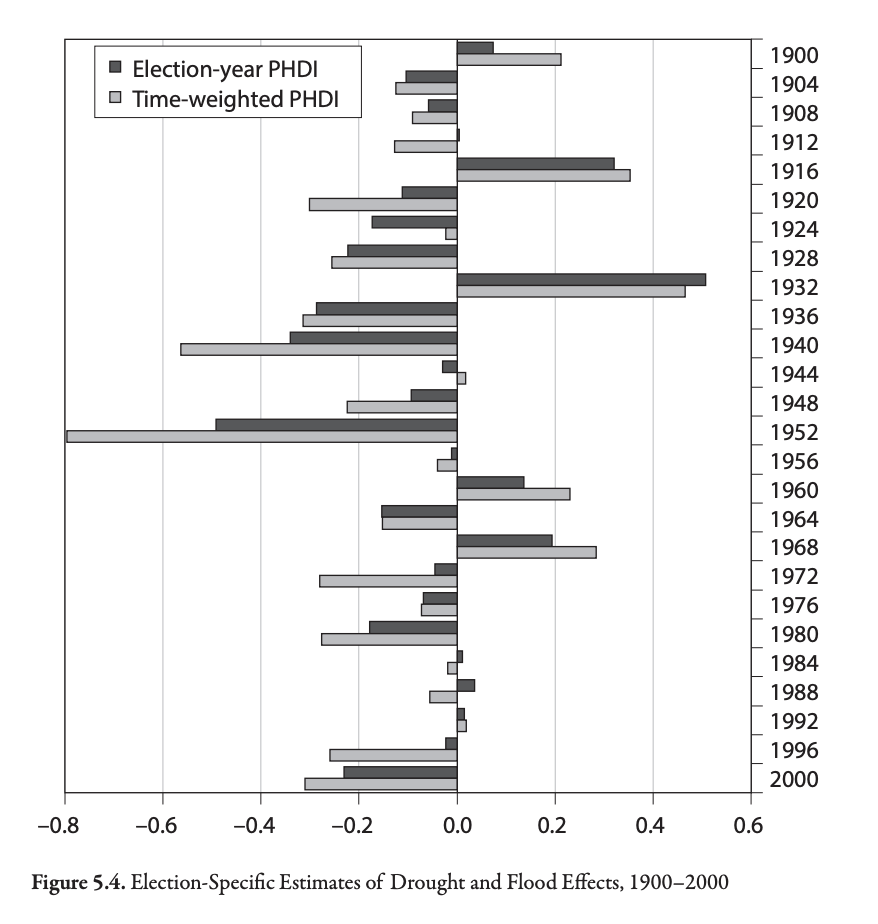
Summary

In Chapter 5, Achen and Bartels present evidence that voters enage in blind retrospection, punishing elected officials for events outside of their control.

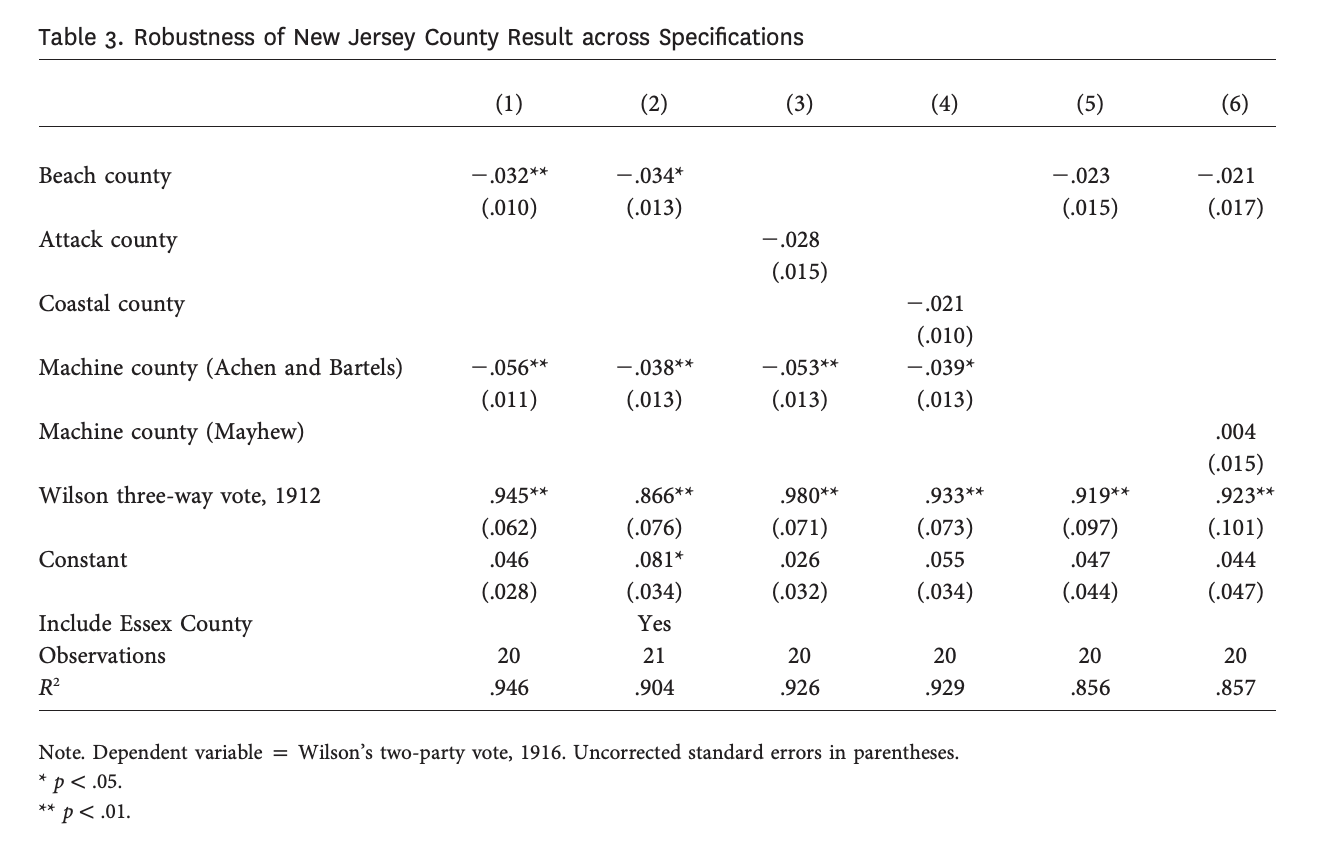
  • They show that Woodrow Wilson’s vote totals in 1916 appear to be lower in beach counties during a summer when shark attacks in New Jersey were particularly salient

  • They suggest this phenomena is more general, by showing how extreme weather (droughts and floods) negatively impacts incumbent vote share.

But how robust are these results?

Do Shark Attacks Really Sway Elections
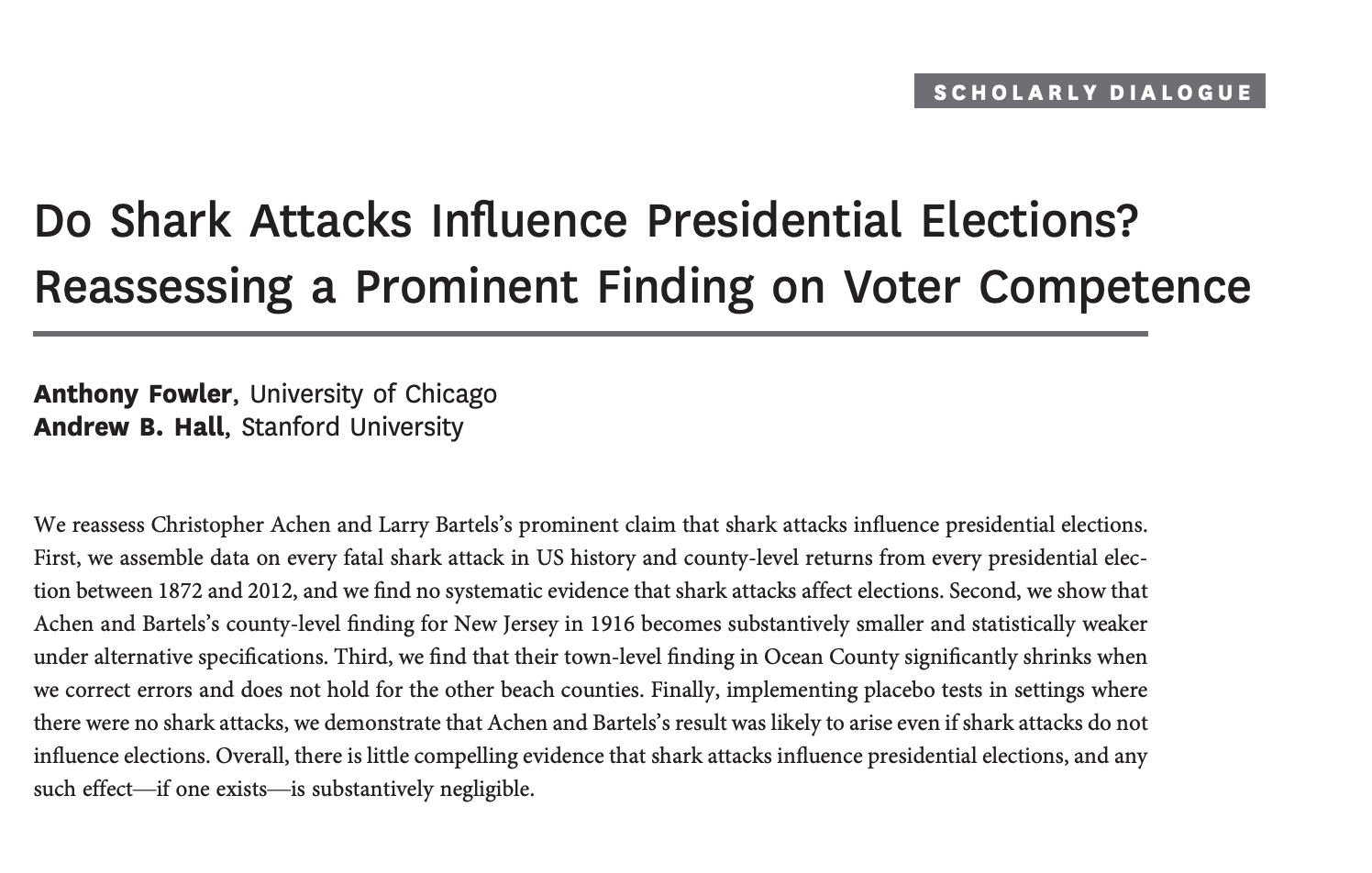
Do Shark Attacks Really Sway Elections
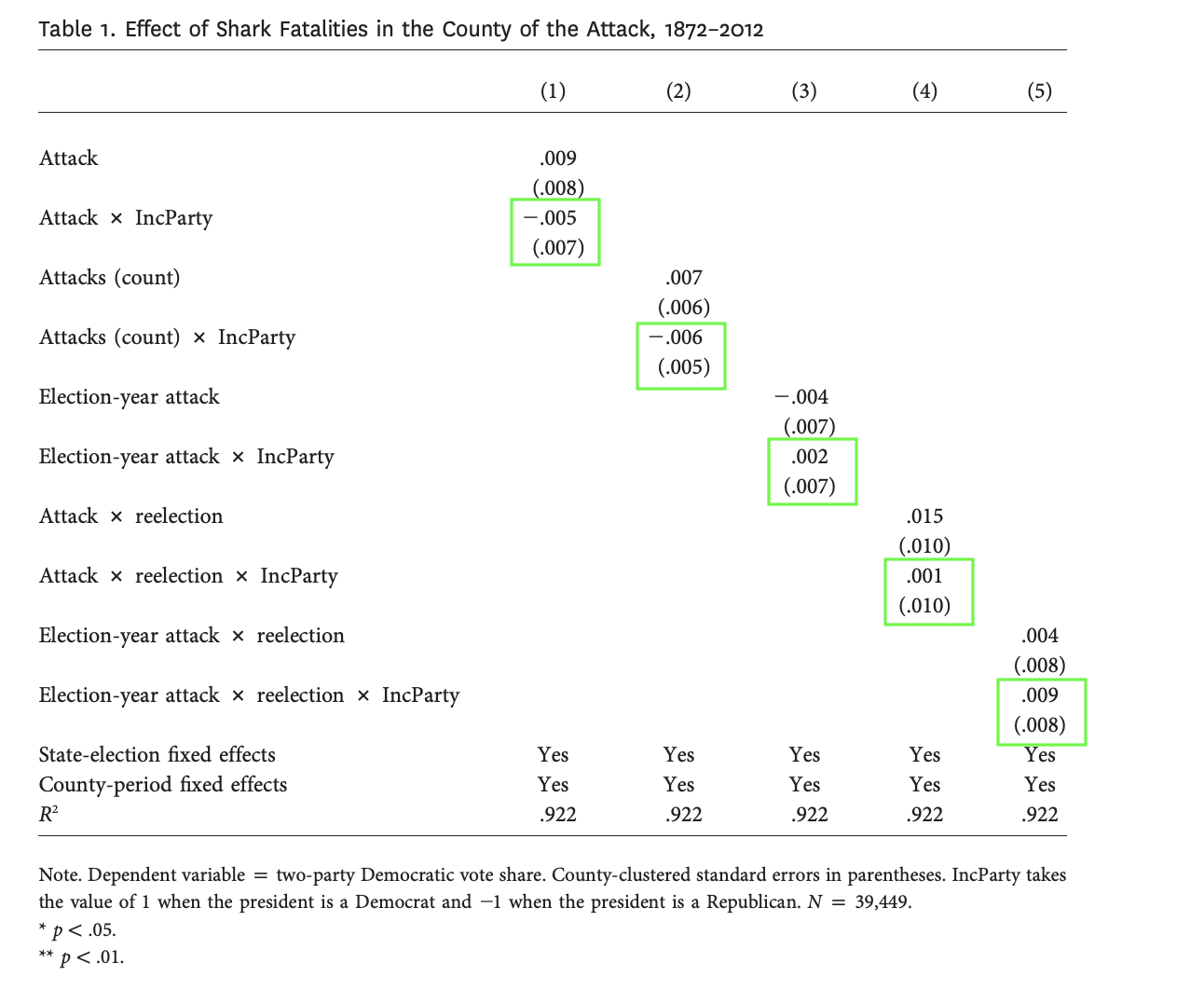
Did Shark Attacks Influence the 1912 Election
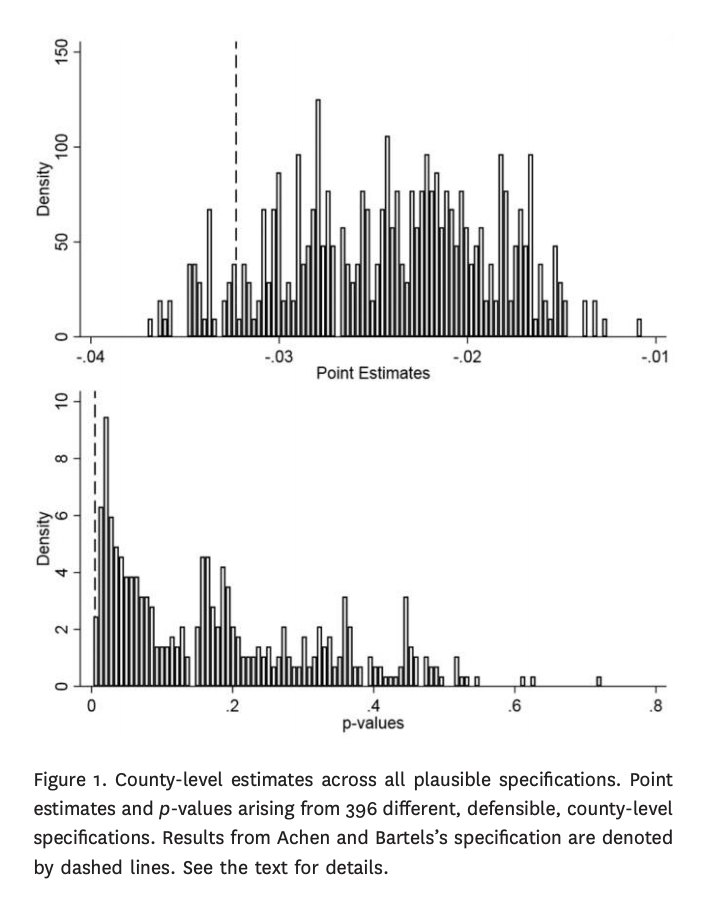
The Garden of Forking Paths
Summary

Economic Voting

Achen and Bartel’s Second Critique

  • If shark attacks and droughts were the only evidence against retrospective voting, maybe we wouldn’t feel so bad

  • But Achen and Bartels then attack the supposed rational foundations of retrospective voting based on economic evaluations

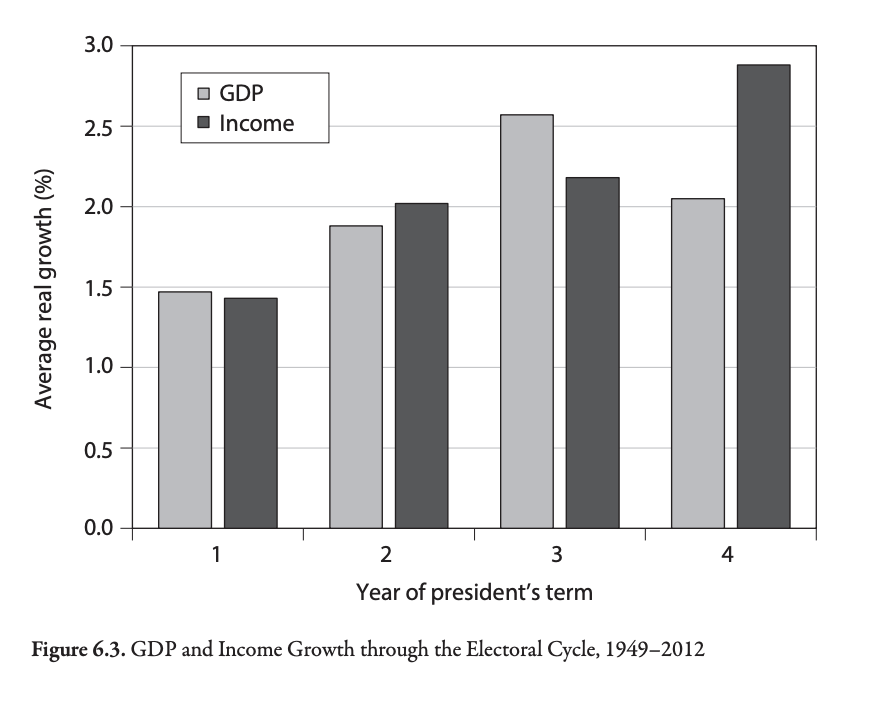
Critique of Economic Voting (Chapter 6)

  • Voters are myopic

  • Do a poor job predicting competence

  • May be open to manipulation

Figure 1: Voters are Short sighted and influenced only by recent economic events
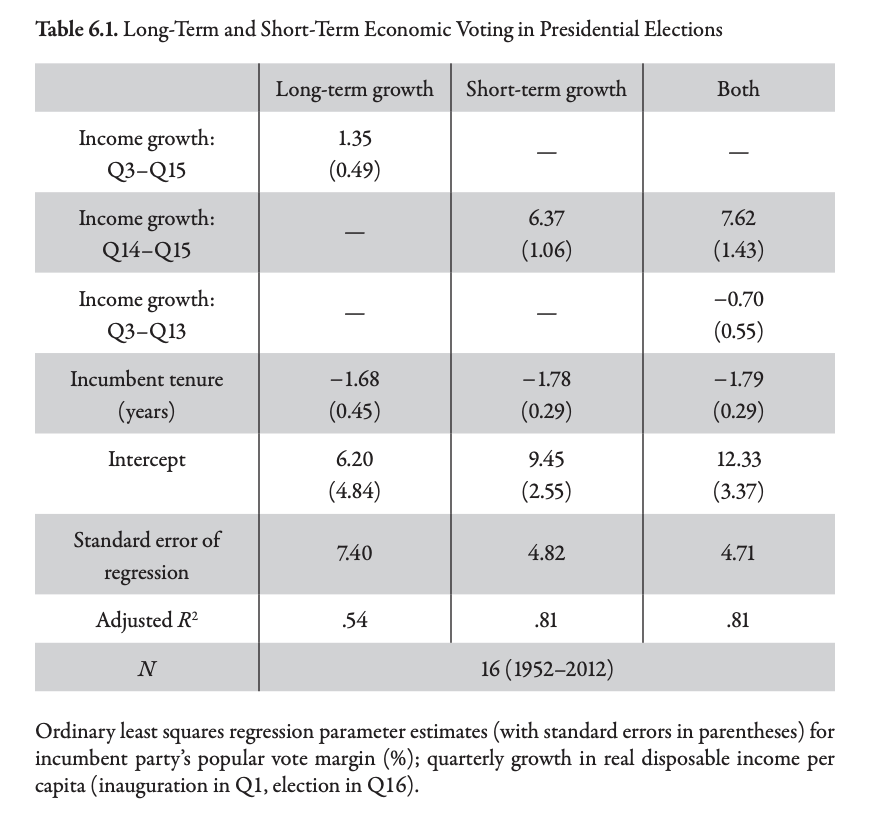
Figure 2: Voters Do a Poor Job of Selecting Competent Leaders
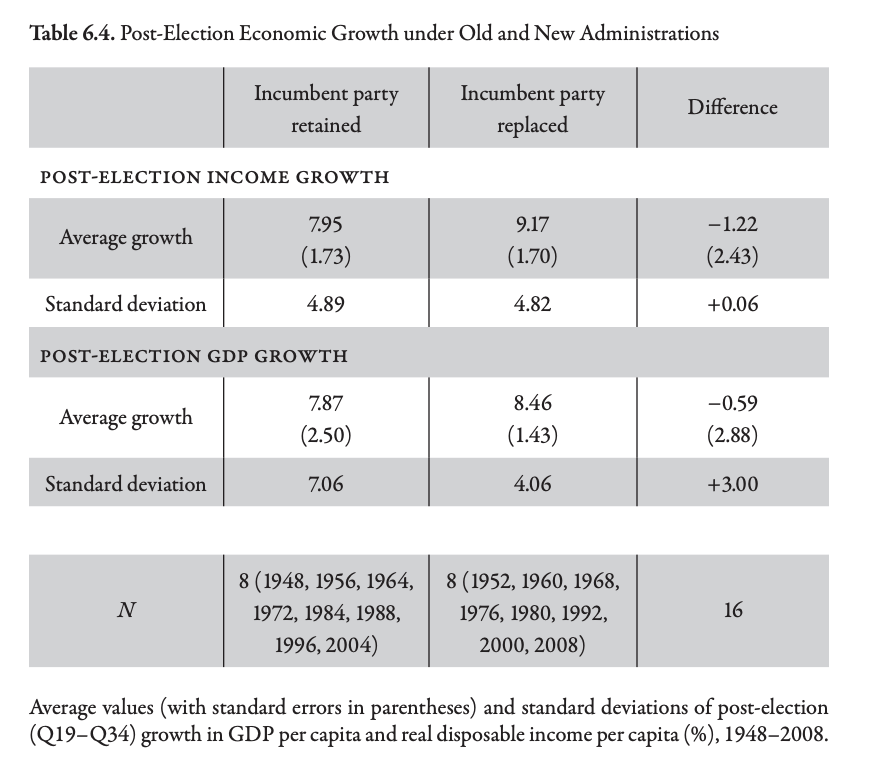
Figure 3: Voters do a poor job of selecting competent leaders
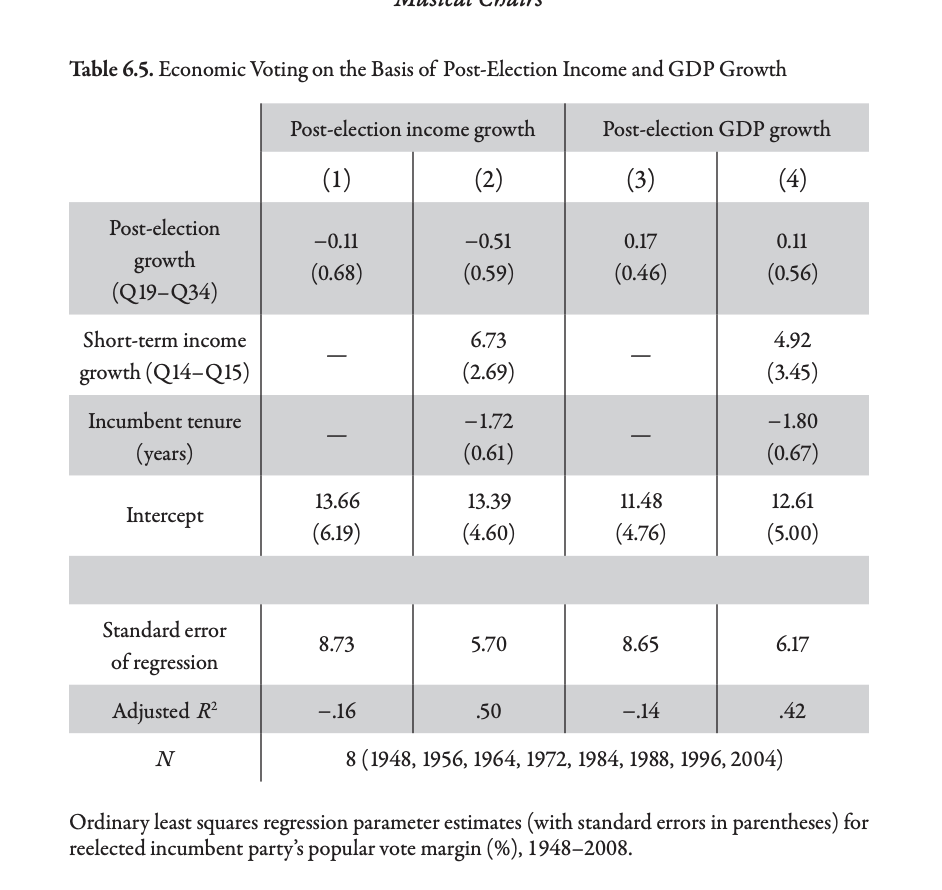
Figure 4: Voters May be Subject to Manipulation/Electoral Business Cycles

Summary

  • Theories of Retrospective Voting seek to offer an alternative acount of democratic accountability that more realistically reflects the abilities of average citizens

  • Rather than assuming coherent beliefs, complete knowledge, RV asks citizens to select good leaders and sanction bad leaders using assessments of their welfare as indicator of competence

  • Critics of RV contend that retropsective evaluations are:

    • Haphazard: Citizens punish elected officials for things they have know control over
    • Myopic: Only recent economic evaluations seem to matter, can be manipulated/biased.

A Realist Theory of Democracy

A Realist Theory of Democracy

  • “The primary sources of partisan loyalties and voting behavior … are social identities, group attachments, and myopic retrospections, not policy preferences or ideological principles.”

  • “How can we tell in any given case that identity is the key moving force?”

The Very Basis of Reasons (Chapter 8)

  • Summarizes critique of two theories of democracy
    • Populist folk theory
    • Rationalistic retrospective theory
  • Traces the decline and reemergence of a more “realist” view of democracy with a focus on pluralist group conflict
    • What explains this decline and re-emergence of groups in political theory and science?
    • What needs to be done to “develop a modern group-theoretic understanding of political attitudes and behavior”

Evidence of Group Identity (Chapter 9)

Chapter 9 presents evidence of the important of “identities” to understanding political behavior using three types of evidence:

  • Historical analysis of Catholic voting behavior

  • Time series cross sectional survey analysis of the partisan identity and policy beliefs of White Southerners

  • Panel survey analysis of abortion attitudes and partisanship

Historical analysis of Catholic voting behavior

  • What are the key takeaways from Figure 9.1?
  • What evidence supports the claims:
    • “[T]he impact of Kennedy’s candidacy on Catholic support for the Democratic Party was temporary” (p. 245)
    • “It is hard to imagine a clear demonstration of the political impact of group attachments and the trade offs among them” (p. 244)
  • Why was “the social significance of a Catholic presidential candidacy … no longer sufficient to produce substantial deviations from accustomed voting behavior” (p. 246)

The Realignment of Partisan Identities in the South

Achen and Bartels present an alternative interpretation of realignment in the south emphasizing the role of social identities over standard accounts that emphasized partisan policies using the following evidence:

  • Analyzing trends in PID and Voting overtime (Fig 9.1) and by age cohort (Fig 9.2)

  • Analyzing trends in PID by policy position (Fig 9.4, 9.5)

  • Regression analysis predicting PID with feelings toward Southerners over time (Table 9.1)

PID, Gender and Abortion

  • Who are we talking about?

  • Who changes parties given attitudes about abortion?

  • Who changes attitudes about abortion given party?

Pitfalls of Group Identity (Chapter 10)

Achen and Bartels conclude by considering the role of partisan identities in politics, and look at:

  • Partisan misperceptions of party positions

  • Partisan misperceptions of objective facts

  • The impact of scandals on unrelated partisan policies

Partisan misperceptions of party positions

  • What do we learn from Figure 10.1

  • How do individuals at the ends differ from individuals at the center of the scale

  • Why are these differences important

Partisan misperceptions of objective facts

  • What are the key takeaways from table 10.1 and figure 10.2?

  • How do these results relate to our earlier discussions of misinformation?

The impact of scandals on unrelated partisan policies

  • What are the key coefficients in Table 10.2 and 10.3 for Achen and Bartel’s argument

  • How compelling and consistent are these results?

Midterm Review

Are citizens up to the tasks democracy requires?

In your groups, write down:

  • An argument for or against competence from readings and concepts we’ve discussed so far

  • A counter-argument to this claim

  • A counter to this counter

References

Ansolabehere, Stephen, Jonathan Rodden, and James M Snyder. 2008. The strength of issues: Using multiple measures to gauge preference stability, ideological constraint, and issue voting.” American Political Science Review 102 (2): 215–32.
Converse, P E. 1964. The nature of belief systems in mass publics.” In Ideology and discontent, edited by D Apter. Free Press.
Zaller, John, and Stanley Feldman. 1992. A simple theory of the survey response: Answering questions versus revealing preferences.” American Political Science Review, 579–616.